
Kamarupa’s Sword: The Day That Broke Khilji
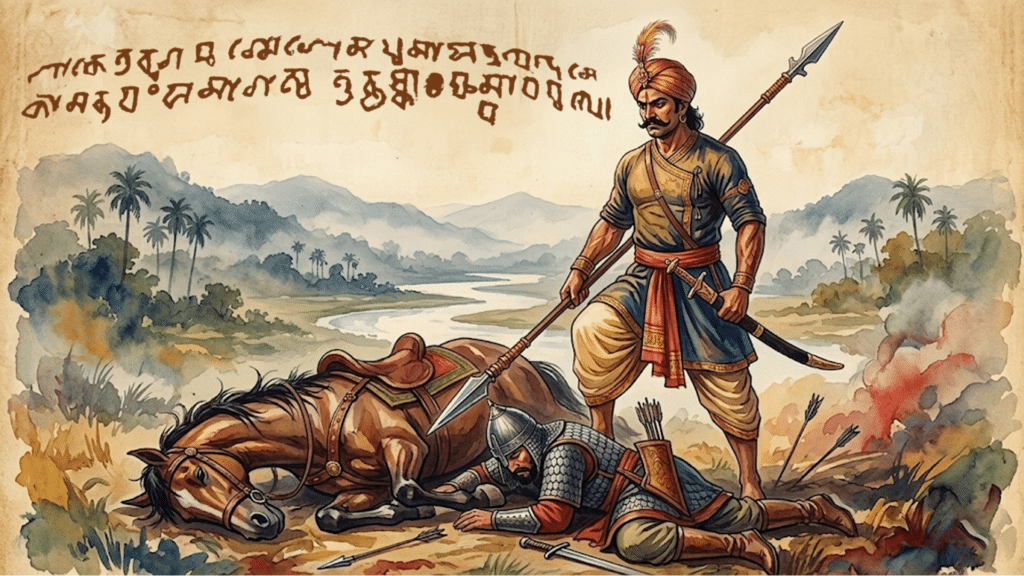
There are rivers that remember. The Brahmaputra is one of them. Broad, patient and deceptively calm, carrying in its silt the memory of kings, invasions and battles that never quite made it into the grand narratives of empire. The Battle of Saraighat was one of them. But there was another, that took place on this day, four-and-a-half centuries ago. It was here, in the early thirteenth century, that Prithu, the last great ruler of Kamarupa, met the advancing force of Bakhtiyar Khilji and broke it. This day, largely unmarked, rarely commemorated, marks one of the most decisive yet underexplored victories in the history of eastern India. It was not merely a military triumph. It was a moment when geography, strategy and civilisational resolve converged to halt an expansion that had already devastated much of the Gangetic plains. A Kingdom at the Edge By the time Prithu emerged as a significant political force, Kamarupa was no longer the consolidated power it had once been. The earlier dynasties had fractured, authority had devolved to local chieftains and the western frontiers, stretching toward present-day Bengal, had become porous. Yet this fragmentation concealed a different kind of strength. Kamarupa was not a monolithic state; it was a network of local powers, tribes and communities deeply attuned to the land they inhabited. Its rivers were unpredictable, its forests dense, its terrain unforgiving. For an outsider, it was not just a kingdom, it was a labyrinth. Prithu, often identified with Vishwasundara Deva in inscriptional records, inherited not a stable empire from his predecessor Vallabha Deva, but a volatile frontier. His significance lies precisely in how he transformed this apparent weakness into a formidable defence. The Advance of Khilji By the early 1200s, Bakhtiyar Khilji had already carved a path of destruction across eastern India. From the sacking of great centres of learning like Odantapuri and Vikramashila to the annihilation of Nalanda University, his campaigns were marked not just by conquest, but by systematic cultural devastation. The Persian chronicle Tabaqat-i-Nasiri, authored by Minhaj-i-Siraj, records these events with stark clarity: “They captured the fortress, and acquired great booty. The greater number of inhabitants of the place were Brahmans… and they were all slain.” Khilji’s ambition did not end in Bengal. Having established control over regions like Lakhnauti, he turned eastward, seeking access to Tibet through Kamarupa. It was a campaign driven not just by expansion, but by a desire to control trade routes and extend ideological dominance. He wrote to the ruler of Kamarupa, requesting passage. Prithu refused. Strategy Against Force Khilji advanced with approximately 10,000 cavalry, a force that had crushed kingdoms far larger than Kamarupa. But Prithu understood something fundamental: this was not a war that could be won through conventional confrontation. Instead, he turned to strategy. The Tabaqat-i-Nasiri records: “Prithu ordered the destruction of all resources—food, supplies, and infrastructure—along the route.” It was a scorched-earth policy of remarkable foresight. Villages were emptied, granaries destroyed, pathways obscured. The invading army, accustomed to sustaining itself through plunder, found itself in hostile terrain with nothing to consume. Hunger set in. Desperation followed. The chronicle notes: “Khilji’s men killed and ate their own horses to feed themselves during this long march”. This was the first fracture. The invader had been slowed, not by armies, but by absence. The Geography of Resistance As Khilji’s forces pushed deeper, they encountered another layer of resistance. Prithu had mobilised a coalition of local tribes—the Koch, Bodo and Keot—each intimately familiar with the terrain. The Tabaqat-i-Nasiri observes: “Prithu had mobilized a diverse coalition of local tribes…who were masters of using bamboo spears.” This was not warfare in the conventional sense. It was fragmentation: ambushes, sudden strikes, disappearances into forest and river. The terrain itself became a weapon. Khilji’s army, trained for open battlefields, found itself disoriented. Every advance came at a cost. Every retreat was harried. By the time they approached the Brahmaputra’s tributaries, they were no longer an advancing force, they were a retreating one. The Breaking Point The critical moment came at a stone bridge, identified with the region of Silsako, across a tributary of the Brahmaputra. Here, Khilji’s retreat collapsed. The Tabaqat-i-Nasiri records simply that the bridge failed. Local memory attributes it to deliberate destruction, or even to the region’s long association with esoteric practices. What matters is the outcome: Khilji was trapped. Cut off from retreat, his forces scattered, he sought refuge in a temple. The chronicle notes: “Khilji took refuge in a Hindu idol-temple”. There is a stark irony here. A commander who had razed temples across the plains now found himself sheltering within one, seeking protection from the very forces he had sought to erase. Prithu did not hesitate. He ordered the construction of a bamboo palisade around the temple: “Prithu ordered a spiked-bamboo palisade to be constructed around the temple, effectively trapping Khilji inside.” The hunter had become the hunted. Collapse and Flight Though Khilji eventually managed to escape with a handful of men, the campaign was effectively over. The once-feared general fled back toward Bengal, his army shattered, his ambitions undone. The Tabaqat-i-Nasiri places his retreat and death in 602 Hijri, corresponding to 1206 CE. Local corroboration comes from the Kanhai Boroxi Bowa Xil inscription: शाक ११२७शाके तुरगयुग्मेशे मधुमासत्रयोदशे ।कामरूपं समागत्य तुरुष्काः क्षयमाययुः ।। In Śaka 1127, on the 13th day of the Month of Honey (Chaitra), upon arriving in Kamarupa the Turks perished. The chronological alignment is precise: Śaka Year + 79 = Christian Year; Śaka 1127 + 79 = 1206 AD.Christian Year – 622 + 3% = Hijri Year; 1206 AD – 622 + 3% = 602 Hijri. This is not merely inscriptional rhetoric. It is historical confirmation: Khilji’s eastern campaign ended here. A Second Challenge The eastern frontier did not remain quiet for long. Another invasion followed, led by Ghiyasuddin Iwaj Khilji, who adopted a naval strategy to navigate the riverine terrain. The Tabaqat-i-Nasiri records that this campaign, too, ultimately failed, undermined by logistical challenges and external pressures. Local evidence from the
Jairam Ramesh’s 2009 video comparing Gandhi, Nehru, and Jinnah to Hindu trinity resurfaces
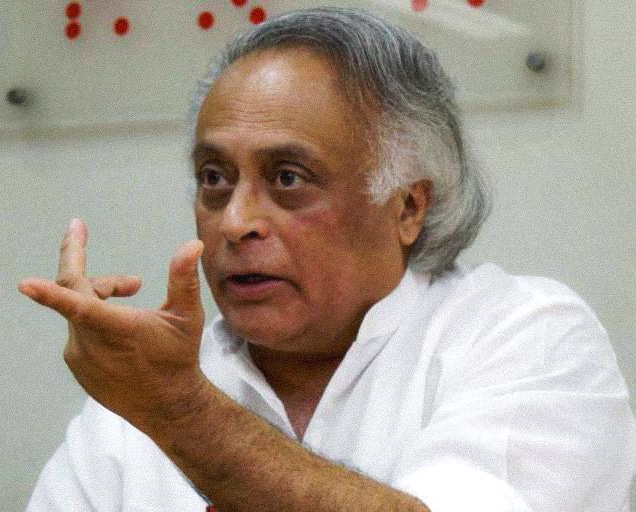
A video from 2009 featuring senior Congress leader Jairam Ramesh has resurfaced online. The clip, now widely circulated on social media, captures Ramesh drawing parallels between key figures of India’s past and the Hindu trinity. In the video, Ramesh speaks about Mahatma Gandhi, Jawaharlal Nehru and Muhammad Ali Jinnah, comparing them respectively to Lord Brahma, Vishnu and Shiva. His remarks have since sparked discussions about the appropriateness of using religious symbolism to interpret historical figures. The Resurfaced Clip The footage shows Ramesh addressing an audience at a public event, where he attempts to connect India’s political history with Hindu philosophical ideas. He likens Gandhi to Brahma, the creator, suggesting that Gandhi laid the ideological and moral foundation for India’s independence movement. Ramesh then compares Nehru to Vishnu, the preserver, crediting him with building and sustaining India’s democratic institutions in the years following independence. However, his comparison of Jinnah to Shiva often associated with destruction has drawn the most attention and criticism. Many critics argue that equating Jinnah with the “destroyer” carries negative connotations, particularly given his central role in the events leading to Partition. Political Reactions The resurfaced video has prompted reactions from across the political spectrum. Several leaders have criticized Ramesh’s remarks, calling them inappropriate and insensitive. They argue that invoking religious imagery in political discourse, especially when discussing historical figures, can be divisive and hurt sentiments. Some commentators have also questioned the broader use of symbolic analogies in political narratives, noting that such comparisons can oversimplify complex historical realities. Meanwhile, members of the Congress party have defended Ramesh, emphasizing that the remarks were made years ago in a specific context. According to them, the intent was to present history through a familiar cultural framework rather than to offend or demean. Historical Context of the Analogy Ramesh’s analogy draws from the concept of the Trimurti in Hindu philosophy, which represents the cycle of creation, preservation, and destruction. Gandhi’s role in shaping India’s freedom struggle through non-violence and truth is often seen as foundational, aligning with the idea of creation. Nehru’s leadership in establishing institutions and governance structures after independence reflects the role of preservation. Jinnah’s political leadership, which culminated in the Partition of India in 1947, is viewed by many in India through the lens of division and upheaval. This association is what makes the comparison to Shiva particularly sensitive and controversial. Social Media Amplification The renewed attention to the video highlights the role of social media in reviving past statements and placing them in a contemporary context. The clip has been widely shared, drawing a mix of reactions—from criticism and outrage to attempts at contextual interpretation. Observers note that such resurfaced content often gains traction quickly, especially in politically charged environments. Congress Response and Clarifications So far, there has been no direct clarification from Jairam Ramesh regarding the resurfaced clip. However, Congress leaders have reiterated the party’s commitment to secularism and inclusivity. They maintain that isolated remarks from the past should not be used to define broader ideological positions. Broader Debate on Historical Interpretation The controversy has also reignited discussion about how historical figures are interpreted in public discourse. Leaders like Gandhi, Nehru, and Jinnah represent complex legacies that are often viewed differently across regions and political perspectives. While metaphors can help simplify historical narratives, they can also lead to misinterpretation or controversy when they intersect with religious beliefs. Sensitivity Around Religious Symbolism India’s diverse and deeply rooted religious traditions make the use of sacred imagery particularly sensitive. The Hindu trinity holds immense spiritual importance, and its use in political commentary can provoke strong reactions if perceived as inappropriate. Experts often caution that while cultural references can make communication more relatable, they must be used carefully in a pluralistic society. The Role of Media The episode has also brought attention to the role of media in amplifying such issues. Analysts stress the importance of responsible reporting that provides context and balanced perspectives, rather than focusing solely on provocative elements. Conclusion The resurfacing of Jairam Ramesh’s 2009 remarks underscores how past statements can re-emerge and spark new debates in the digital age. His analogy linking Gandhi, Nehru, and Jinnah to the Hindu trinity has once again highlighted the delicate intersection of politics, history, and religion in India. As discussions continue, the incident serves as a reminder of the need for careful communication and nuanced understanding when addressing historically and culturally significant subjects.
Govt employee attacked by TMC goons in Ranaghat, West Bengal
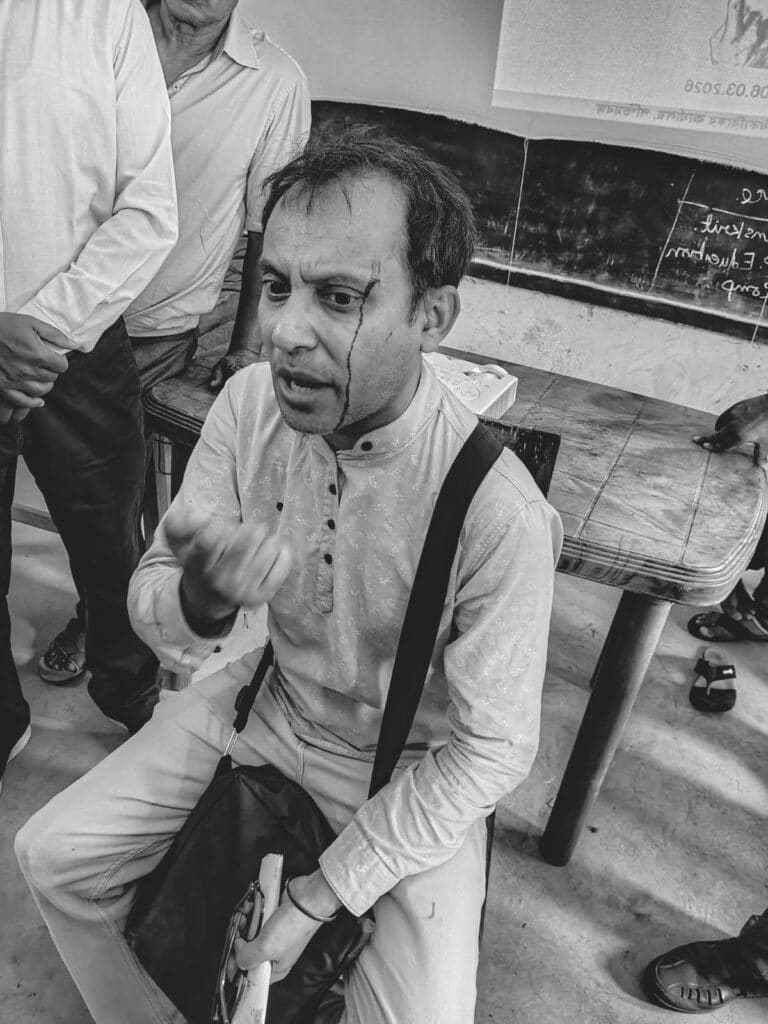
A polling official has alleged that he was attacked during a training session in Ranaghat, West Bengal, after objecting to the display of certain images. The official, Saikat Chatterjee, said the incident took place at Ranaghat Debnath Institution High School during training for election staff. He objected to images of the Chief Minister and the Jagannath Temple being shown, stating that it violated the Model Code of Conduct. According to Chatterjee, the situation escalated after his objection. He claimed that a man responded rudely, and when he asked for the individual’s identity, a group of people allegedly surrounded and assaulted him. Saikat Chatterjee reiterated that the incident occurred in the presence of the Block Development Officer. Chatterjee has alleged that those involved are associated with the Trinamool Congress, although there has been no official confirmation regarding the identities or affiliations of the accused individuals. The incident has raised concerns about discipline and adherence to electoral rules during official training sessions. Authorities have not yet issued a detailed statement or confirmed whether an investigation is underway
“Will tear Himanta Biswa Sarma into pieces”: AIUDF’s Badruddin Ajmal
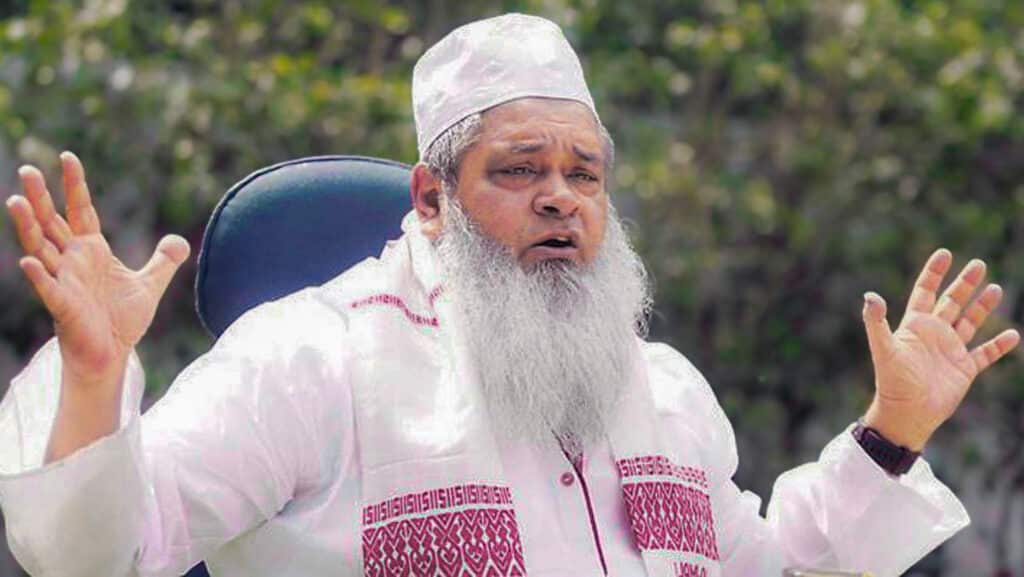
A controversy has erupted in Assam after a video surfaced showing Badruddin Ajmal making a provocative remark against Chief Minister Himanta Biswa Sarma, in which he said he would “tear him into pieces.” The statement was reportedly made in response to alleged derogatory comments targeting the Miya Muslim community, which Ajmal strongly condemned. The remarks come at a politically sensitive time, with elections approaching in the state. Ajmal, who leads the All India United Democratic Front, defended his statement as a reaction to offensive comments made against the community. However, his words have drawn sharp criticism from various quarters, with many calling them inflammatory and irresponsible. Critics argue that such rhetoric could deepen divisions and disrupt communal harmony in the state. Several political leaders have urged Ajmal to apologise, while some have called on election authorities to take note of the incident. The video has since gone viral, triggering widespread debate and concern among the public. The controversy has once again highlighted the need for restraint in political discourse, especially during election periods. Many observers stress that leaders must be mindful of their language and avoid statements that could incite tension, emphasizing the importance of promoting unity and peaceful coexistence among communities.
Idol at Shivpuri temple vandalised during Ram Navami
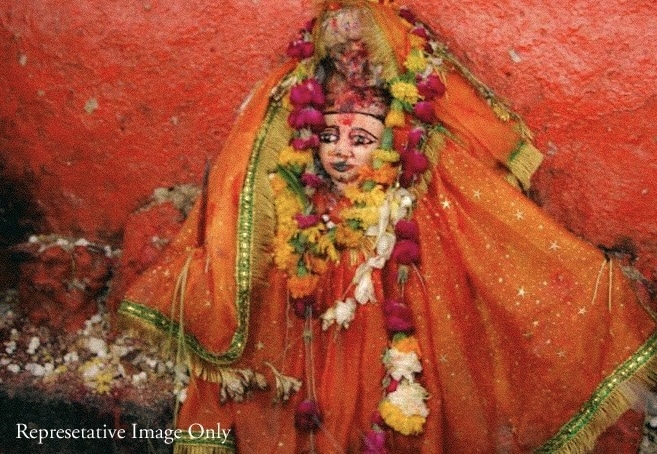
An incident at a temple in Shivpuri during Ram Navami has drawn attention after a video surfaced on social media, reportedly showing a man identified by some as Danveer Jatav damaging a Durga idol. The individual is alleged to be associated with the Bhim Army. The video also appears to capture him making derogatory remarks aimed at members of the Brahmin community, along with references to legal provisions related to the protection of Scheduled Castes and Scheduled Tribes. Authorities have urged caution, stating that the authenticity and context of the video are yet to be fully verified. Police in Shivpuri have launched an investigation to establish the facts, including the identity of the individual and the circumstances surrounding the incident. The incident has triggered widespread discussion online, with some demanding accountability, while others have called for restraint until verified information is available.
Rights of Prison Inmates: Balancing Justice and Dignity
Across the world, prisons remain one of the most debated and sensitive components of the justice system. While their primary purpose is to detain individuals convicted of crimes, modern perspectives increasingly emphasize that incarceration should not strip a person of their basic human dignity. Nations differ significantly in how they treat prisoners, but there is a growing global consensus that inmates are entitled to certain rights. Governments, alongside non-governmental organizations and international bodies, continue to push for reforms that ensure humane conditions and protect the fundamental rights of those behind bars. Such questions also keep coming up in the background, as India actively seeks extradition of its evading criminals. In India, the legal framework surrounding prisoners’ rights has evolved through constitutional provisions, statutory laws, and judicial interpretations. Although imprisonment naturally limits certain freedoms, it does not render an individual rightless. The Constitution of India recognizes that prisoners remain “persons” under the law and are therefore entitled to a range of protections, albeit with reasonable restrictions necessitated by incarceration. At the very outset, the Indian Legal system makes an endeavor to do away with any form of unjust conviction. The Constitution also provides critical protections against arbitrary or unjust punishment. These safeguards are particularly significant for individuals who may already be vulnerable within the criminal justice system. One such protection ensures that a person cannot be convicted for an act that was not considered an offence at the time it was committed. Additionally, the principle of double jeopardy prevents an individual from being tried or punished more than once for the same offence. Another important safeguard protects individuals from being compelled to testify against themselves, thereby upholding the principle against self-incrimination. These provisions ensure that over-all, the rule of law prevails and individuals are shielded from misuse of state power. Furthermore, the moment a person is arrested, a set of legal protections comes into effect. One of the most important among these is the right to consult and be defended by a legal practitioner of one’s choice. This right is not limited to trial proceedings but begins at the time of arrest itself. In cases where an accused person cannot afford a lawyer, the court is obligated to provide legal representation at the expense of the state. Even if the accused declines legal assistance, courts may appoint a lawyer to ensure that justice is not compromised. This reflects the principle that a fair trial is a cornerstone of the justice system. However, in the event that an accused remains unable to prove his innocence, and faces the prospect of inevitably going to prison, the Legal framework still makes vital attempts to ensure the dignity and safety of the incarcerated. Every Indian has the Fundamental Right to life and personal liberty, and the same right is extended to prison inmates as well. For prisoners, this includes the right to live with dignity and to be free from torture, cruelty, or degrading treatment. It also encompasses the right to a speedy trial, ensuring that individuals are not subjected to prolonged detention without resolution of their cases. Access to free legal aid is another crucial component, particularly for those who cannot afford legal representation. The judiciary has repeatedly emphasized that deprivation of liberty does not equate to deprivation of humanity. Even behind bars, individuals are entitled to basic human rights and protections. Courts have also recognized the importance of maintaining social and familial connections for prisoners. In various rulings, it has been affirmed that inmates should be allowed to meet family members, friends, and legal counsel. Such interactions are vital for emotional well-being and rehabilitation. Judicial directions have even encouraged provisions that allow prisoners occasional visits to their families under regulated conditions. Beyond legal rights, the physical and mental well-being of prisoners is an important aspect of prison administration. Guidelines such as those found in the Model Prison Manual outline standards for the treatment and maintenance of inmates. These guidelines cover various aspects of daily life in prison, including food, clothing, hygiene, education, and recreational opportunities. They also emphasize the importance of fair wages for work performed by prisoners, recognizing their labor and contribution.Special provisions are made for vulnerable groups, such as pregnant women and nursing mothers. Courts have also issued directives to ensure the welfare of children who may be living with incarcerated mothers, highlighting the need for a humane and compassionate approach. Furthermore, adequate nutrition is a fundamental requirement for maintaining the health of prisoners. State governments are responsible for prescribing dietary standards, taking into account factors such as nutritional needs, regional habits, and climatic conditions. The aim is to provide balanced and sufficient meals that support physical well-being. Authorities also retain the flexibility to revise these standards as needed, ensuring that they remain relevant and effective. Sanitation and hygiene play a critical role in prison environments, where overcrowding and limited resources can pose significant challenges. Proper waste management, drainage systems, and regular cleaning are essential to prevent the spread of diseases. Guidelines emphasize the need to eliminate stagnant water, maintain clean living spaces, and ensure that sanitation facilities are regularly serviced. The hygiene of both the prison environment and the inmates themselves must be carefully managed to safeguard public health. Healthcare is another vital component of prisoner welfare. Prisons are required to have medical facilities that can address the basic health needs of inmates. This includes the presence of qualified medical officers and access to necessary treatments. Special attention is given to prisoners with specific needs, such as those suffering from addiction. Separating such individuals from the general population can help prevent negative influences and allow for more focused rehabilitation efforts. The emphasis on healthcare reflects a broader recognition that prisoners, like all individuals, have a right to medical attention and humane treatment. All in All, The evolving framework of prisoners’ rights reflects a shift in societal attitudes toward punishment and rehabilitation. While prisons serve as instruments of justice, they are also spaces where reform and reintegration should be encouraged.
The Invisible Stage That Built Indian Cinema
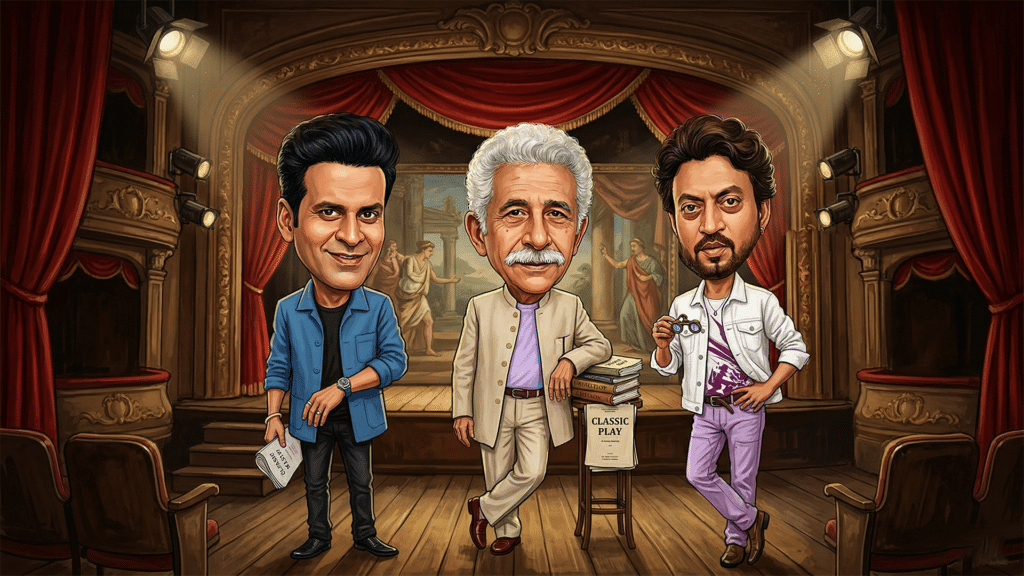
There is a moment before the lights come up, when the stage is still, the audience breathes in unison, and something unspoken begins to gather in the dark. It is in that fragile, electric silence that theatre is born anew each time. And it is from this silence, this living, breathing immediacy, that Indian cinema has drawn some of its deepest truths. While cinema dazzles with scale and digital platforms command attention with immediacy, theatre remains the quiet origin story of Indian performance. It is the invisible architecture beneath the spectacle: the place where actors learn not just how to perform, but how to feel, to listen and to exist truthfully within a moment. On World Theatre Day, one is compelled to look beyond the proscenium arch and into the shadows it casts towards Indian cinema itself. For behind some of the finest performances ever seen on screen lies an older, more demanding, and infinitely more unforgiving teacher: the stage. Where actors are forged Indian theatre is not merely an art form; it is a civilisational inheritance. Its origins can be traced to the Natyashastra by Bharata Muni, a text that did not just codify performance but envisioned it as a total experience, an intricate confluence of drama, music, dance, gesture and emotion. Here, storytelling was never confined to dialogue alone. The body spoke. The eyes carried meaning. Rhythm and silence held equal weight. Actors were not specialists but complete performers—dancers, singers, storytellers—capable of inhabiting an entire emotional universe. Over centuries, this tradition unfolded into a remarkable diversity of forms: from the stylised intensity of Kathakali and the vibrant energy of Yakshagana, to the earthy immediacy of Nautanki. Each form carried its own grammar, yet all shared a commitment to embodied storytelling. During the colonial period, theatre evolved again, absorbing Western dramaturgy, adopting proscenium stages, and emerging as a powerful tool of social and political expression. Organisations like the Indian People’s Theatre Association used performance as resistance, as dialogue, as awakening. By the time cinema arrived, theatre had already done the difficult work, it had built the language. If cinema is an art of illusion, theatre is an art of exposure. There are no retakes on stage. No edits. No background score to heighten emotion or mask inadequacy. The actor stands alone, armed only with breath, body and presence, before an audience that responds in real time. This is where discipline is born. Theatre demands voice projection that can reach the last row without losing intimacy. It requires body language that communicates as much as words. It insists on emotional continuity, on sustaining truth from the first line to the final bow. But beyond technique, theatre teaches something rarer: presence. An actor trained in theatre learns to listen, to truly hear a co-actor, to react rather than perform, to allow a scene to unfold organically. Timing becomes instinctive. Silence becomes expressive. Dialogue begins to feel lived rather than delivered. This is why theatre-trained actors often carry a certain stillness, a groundedness that is difficult to manufacture. They do not chase the moment; they inhabit it. From Stage to Screen It is no coincidence that some of the most respected names in Indian cinema began their journeys in theatre. Consider Naseeruddin Shah and Om Puri, two towering figures whose performances altered the very texture of Indian acting. Rooted deeply in theatre and shaped by institutions like the National School of Drama, they brought a startling honesty to the screen. There was no excess in their performances. No indulgence. Just truth. When Om Puri portrayed a struggling farmer or a conflicted father, the performance did not feel constructed. It felt observed, almost documentary in its authenticity. Naseeruddin Shah, with his precision and restraint, demonstrated that acting could be intellectual without losing emotional depth. Then came Irrfan Khan, perhaps the most globally recognisable embodiment of theatre’s influence on cinema. His performances carried an almost unsettling naturalism. He did not act scenes; he allowed them to happen through him. His silences often spoke louder than dialogue, his gaze carrying the weight of entire narratives. Actors like Pankaj Kapur and Manoj Bajpayee extended this lineage, bringing rigour, emotional intelligence, and a deep respect for craft. Bajpayee has often spoken about how theatre reshaped his understanding of acting, not as performance, but as presence. In more recent years, Nawazuddin Siddiqui and Rajkummar Rao have carried this tradition forward. Their performances are marked not by glamour but by transformation, by an ability to disappear entirely into character. What unites all these actors is not style, but training, a foundation built in rehearsal rooms, on modest stages, before audiences that demand authenticity. The Invisible Engine Beyond institutions and established names lies a more elusive force, the independent theatre circuit. Unfunded, experimental, often operating in borrowed spaces, independent theatre is where risk thrives. It is where young actors fail publicly, repeatedly, and productively. Where scripts are rewritten in rehearsal. Where performance is not polished for perfection but sharpened through experimentation. This ecosystem is cinema’s unseen laboratory. The independent stage allows for a kind of creative freedom that mainstream cinema rarely affords. It engages directly with social realities, political tensions, and personal conflicts. It is intimate, immediate, and often uncomfortable. And it is here that many cinematic revolutions quietly begin. The realism that defined India’s parallel cinema movement, the complexity of contemporary indie films, the rise of character-driven storytelling on OTT platforms, all of these bear the imprint of independent theatre. It is not a coincidence. It is continuity. In an era dominated by streaming platforms, algorithms, and shrinking attention spans, one might wonder if theatre still matters. But anyone who has sat in a darkened auditorium knows the answer instinctively. Theatre offers something no screen can replicate: presence shared in real time. Every performance is unique. Every pause lands differently. Every breath is collective. There is a vulnerability here, a risk, that cannot be edited out or digitally enhanced. For actors, this remains invaluable. Many established film actors
Heavyweights advance as European qualification for FIFA World Cup enters final stage

The European play-off semifinals for the FIFA World Cup 2026, held on March 26, 2026, delivered few surprises as traditional heavyweights like Italy and Sweden advanced to the final stages. With the number of European slots increased to 16, eight teams took one more step towards booking their tickets to the summer finale in North America. PATH A: ITALY VS BOSNIA AND HERZEGOVINA Italy book a final versus Bosnia and Herzegovina after a professional 2-0 victory over a young Northern Ireland team. After missing out on 2 consecutive World Cup finals, the Italians are a step away from finally breaking the rut they were stuck in, as they face a Bosnia and Herzegovina team which made the final by the skin of their teeth versus Wales, who have faced penalty heartbreak once again after their Euro 2024 qualification defeat on penalties. The Bosnians were on the brink of elimination when their legendary talisman, the 40-year old Edin Džeko rose high to head in an equaliser in the 86th minute after Dan James had put the Welsh ahead in the 51st minute. A penalty shootout followed, where Brennan Johnson and Neco Williams missed in quick succession, handing the initiative to the Bosnians, who took full advantage despite missing first in the shootout, with Kerim Alajbegović slotting in the final penalty to break the home crowd’s hearts and send Bosnia into the final. Italy exorcise demons vs Northern Ireland Gennaro Gattuso’s men finally exorcised some of their World Cup demons with a professional 2–0 victory over Northern Ireland in Bergamo. The Azzurri lined up in a 3-5-2, with captain and goalkeeper Gianluigi Donnarumma shoring up a young and versatile 3-man backline of Riccardo Calafiori, Alessandro Bastoni and Gianluca Mancini; an industrious midfield three of Manuel Locatelli, Sandro Tonali and Nicolò Barella; Federico Dimarco and Matteo Politano patrolling the wings with Mateo Retegui and Moise Kean leading the line. Michael O’Neill’s young team also mirrored the Italian formation, with Jamie Donley and Isaac Price leading the line ahead of a midfield of Justin Devenny, Ethan Galbraith and Shea Charles with the experienced Paddy McNair marshalling the backline, as Premier League stars Conor Bradley and Daniel Ballard missed out due to injury. The Italians began brightly, Irish goalkeeper Pierce Charles parrying an early shot from Dimarco which was then cleared before Tonali could pounce on it. However, the hosts could not muster any clear cut opportunities, with Bastoni’s on target header in the 34th minute being deflected and Retegui shooting straight at Charles as the first half drew to a close with the tie scoreless. The second half began in the same vein as the first half, Retegui latching on to an errant back pass from Irish wing back Terry Devlin in the 53rd minute and bore down on goal, but a heavy touch allowed Charles to close down the angle and stop the Italians from going 1-0 up. The hosts were getting close, with Charles pushing away a fierce Kean shot in the 55th minute after Galbraith lost the ball in the middle of the park. However, Charles was powerless to stop the inevitable as Tonali fired in a superb volley in the next minute after a cross from Politano was weakly cleared, putting Italy 1-0 up and setting off wild celebrations from the bench as the entire stadium heaved a sigh of relief. Tonali was at it again as he played in Kean in the 66th minute, Charles stopping well again from the Italian forward. Kean went close again in the 79th minute, his acrobatic finish from Barella’s cross going just wide. However the Italian forward would get his reward just a minute later, as he collected Tonali’s lobbed pass before stepping past an Irish defender and shooting past a stranded Charles, the ball going in off the post. That would be the last big action of the match, as the Italians professionally saw off the match without any risk from the Irish, marching into a final against Bosnia and Herzegovina. PATH B: SWEDEN VS POLAND Two star strikers have set up a final showdown, with Arsenal’s Viktor Gyökeres leading Sweden with a brilliant hattrick while Poland’s talisman Robert Lewandowski ensured his nation was still in contention to make their second successive World Cup finals. Poland began unconvincingly, shockingly going behind in the 42nd minute when Arbër Hoxha rounded Thomas Strakosha and slotted into the empty net. The Poles attacked relentlessly in the second half, and eventually the equaliser came in the 63rd minute when Lewandowski rose highest to head home a corner. Poland struck a second dagger into Albanian hearts in the 73rd minute, when Piotr Zielinski lashed in the winner from deep after Strakosha made a brilliant save to keep the scores level just a minute before. Poland will now face Sweden for a spot in the World Cup after the Scandinavian nation strolled to a 3-1 win over Ukraine. Sweden storm into final While Arsenal fans have been divided over their opinions on Viktor Gyökeres, Swedish fans have no doubts about their love for their star striker. And at the Estadio Ciudad de Valencia in Spain, Gyökeres proved why he is Sweden’s talisman, with a brilliant hattrick which took the nation to the brink of qualification to the World Cup. Sweden coach Graham Potter, without the Premier League’s most expensive player Alexander Isak due to a long-term injury, lined up in their customary 4-4-2. Anthony Elanga partnered Gyökeres up top with a midfield of Benjamin Nygren, Herman Johansson, Jesper Karlström and Yasin Ayari ahead of a 4-man backline of Gabriel Gudmundsson, Victor Lindelöf, Isak Hien and Gustaf Lagerbielke, with Kristoffer Nordfeldt protecting the goal. Ukraine took to the field in a 4-1-4-1 shape, Anatoliy Trubin donning the keeping gloves with Oleksandr Tymchyk and Vitalii Mykolenko patrolling as full backs, while Illia Zabarnyi partnered Valeriy Bondar in the heart of the defence. Ivan Kalyuzhnyi sat in front of the defence, while Viktor Tsygankov, Yehor Yarmolyuk, Heorhiy Sudakov and Oleksandr