
Police raid illegal cattle slaughterhouse in Vejalpur
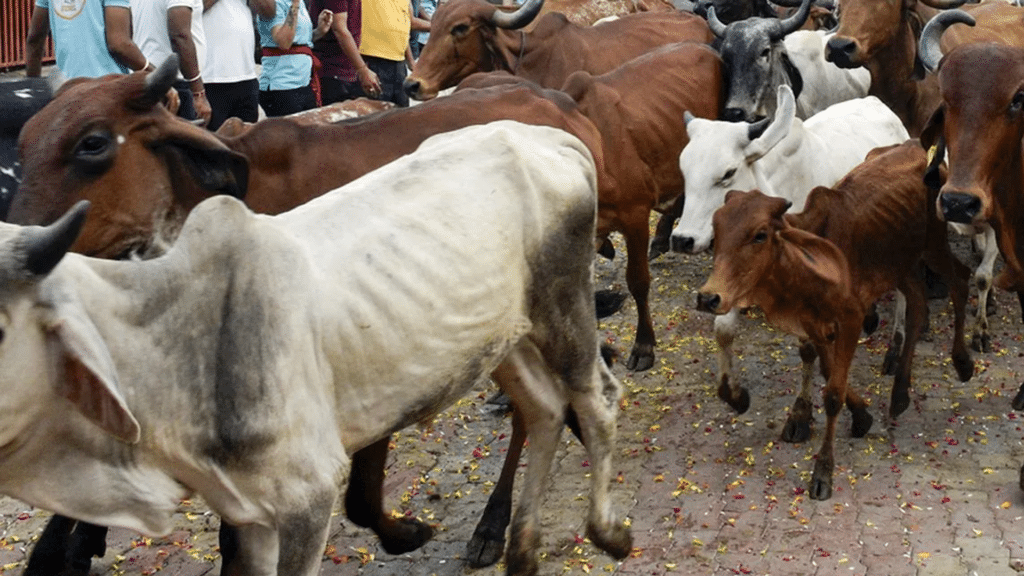
Ahmedabad Police conducted a raid on an illegal cattle slaughterhouse near Sonal Cinema in the Vejalpur area, where officials seized nearly 520 kilograms of suspected cow meat and rescued a live calf. The operation was carried out after police received specific intelligence about unlawful cattle slaughter activities taking place at the location. During the raid, police recovered slaughtering equipment and a large quantity of meat from the premises. Three accused were arrested on the spot, while six others allegedly involved in the operation are currently absconding and being traced by authorities. The seized meat has been sent for forensic and veterinary examination to determine its origin. Police have registered a case under relevant provisions of the Gujarat Animal Preservation Act and other applicable laws. Investigators are also examining whether the illegal slaughterhouse was linked to a wider network involved in unlawful cattle slaughter and meat supply across Ahmedabad. Officials said the investigation is ongoing and further raids and arrests are expected in the coming days.
The Tagore Indian Academia Doesn’t Want to Teach You
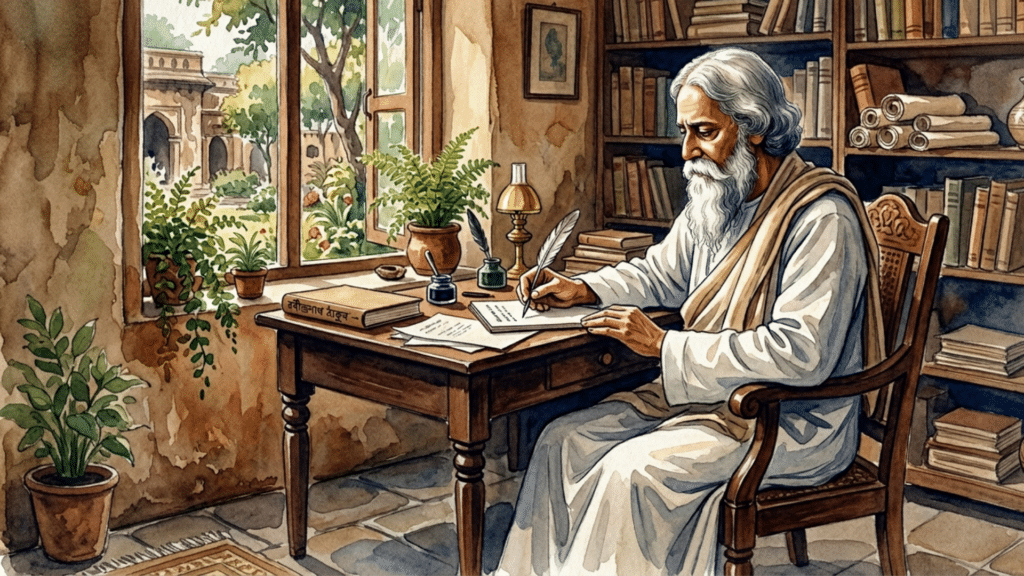
Rabindranath Tagore occupies a strange place in modern Indian intellectual life. He is celebrated everywhere, quoted endlessly and understood very little. The average Indian university student encounters Tagore through a carefully curated set of texts, usually his lectures compiled under Nationalism, perhaps a few poems about universal humanity and the occasional reference to his disagreements with militant nationalism. From this selective reading emerges the standard academic caricature: Tagore as a proto-globalist liberal, suspicious of nationalism, detached from Hindu identity, and comfortably aligned with the modern secular-left worldview. Even Tagore’s calls for Hindu reform are selectively interpreted. His critique of caste rigidity is highlighted, but usually detached from the broader context in which he remained fundamentally committed to Hindu civilisation itself. Unlike Ambedkar, Tagore never concluded that Hindu civilisation was irredeemable. His approach was closer to Gandhi’s: reform society from within while preserving the spiritual and civilisational framework that sustained it. But this is not the full Tagore. In many ways, it is not even the real Tagore. A deeper engagement with his essays, speeches, letters, educational philosophy and social commentary reveals a thinker deeply rooted in Hindu civilisation, profoundly shaped by Upanishadic spirituality, sceptical of aggressive proselytising faiths, anxious about pan-Islamic politics and convinced that Hindu society needed internal reform and civilisational self-confidence rather than self-erasure. The modern academic establishment prefers a sanitised Tagore because the complete Tagore is far more difficult to assimilate into contemporary ideological categories. This selective interpretation is not accidental. A complete Tagore is far more difficult to absorb into the ideological frameworks dominant within modern academia. He cannot easily be classified as a modern secular progressive because his universalism emerged not from Enlightenment liberalism or Marxist internationalism, but from Hindu metaphysics. Nor can he be comfortably appropriated into contemporary left-liberal discourse because he repeatedly expressed concerns about civilisational cohesion, religious exclusivism, and the consequences of Hindu social disunity. The academic establishment therefore preserves only the Tagore it finds usable: the critic of nationalism, not the defender of civilisation; the poet of humanity, not the thinker rooted in dharma. What Tagore Actually Opposed The modern interpretation of Tagore often rests almost entirely on one work: Nationalism. Detached from its historical context, the text is used to portray Tagore as fundamentally hostile to nationalism itself. But this reading collapses the moment one asks a basic question: what exactly did Tagore mean by “nation”? The answer is crucial because Tagore’s critique was never directed at Bharat as a civilisation. What he opposed was a specifically European political phenomenon: the modern nation-state born from industrialisation, militarism, imperial expansion and mass political centralisation. His lectures on nationalism, delivered during the First World War, emerged in the shadow of Europe’s descent into mechanised slaughter. He saw nationalism in the West not as an organic expression of cultural life, but as a machine, an organised system built around production, competition, extraction, and state power. For Tagore, Europe had reduced society into an instrument of political and economic efficiency. The “Nation,” in the Western sense, was not a spiritual or cultural community. It was an organised political apparatus designed to maximise collective power. Industrial capitalism, bureaucratic centralisation, imperial conquest and racial chauvinism were all expressions of this same civilisational tendency. Europe’s nationalism, in Tagore’s eyes, transformed human beings into components within a mechanical system. India, he believed, represented something fundamentally different. Europe’s organising principle was the state.India’s organising principle was civilisation. This distinction lies at the heart of Tagore’s political philosophy and is almost entirely erased in modern academic interpretations. Bharat, for Tagore, was not merely a territorial nation-state. It was a civilisational continuum held together through shared spiritual traditions, sacred geography, philosophical inheritance, social memory and dharma. This is why Tagore’s criticism of nationalism did not amount to a rejection of cultural rootedness or civilisational consciousness. On the contrary, he feared that India, in attempting to imitate Europe’s political model, would lose the very civilisational character that made it unique. Tagore was not calling for rootless globalism. He was arguing for a different civilisational ideal altogether: a universalism emerging from spiritual culture rather than political machinery. His opposition was directed against aggressive state nationalism, not against Bharat’s civilisational identity. He feared the rise of a politics severed from ethics, spirituality and social harmony. To read Tagore as simply “anti-national” is therefore profoundly misleading. He was anti-imperial, anti-mechanistic, and deeply sceptical of the Western nation-state. But he remained profoundly attached to India as a civilisational entity. Tagore’s Civilisational Core At the centre of Rabindranath Tagore’s worldview stood a philosophical framework that was unmistakably Hindu. Modern secular readings often attempt to detach his universalism from its metaphysical foundations, presenting him as a generic humanist untethered from any particular civilisation. But Tagore’s ideas did not emerge from Enlightenment liberalism or modern secular thought. They emerged from the Upanishads, Vedanta and the broader intellectual traditions of Hindu civilisation. The language of his philosophy was deeply dharmic:Brahman.The unity of existence.The sacred relationship between man and cosmos.The idea that divinity permeates all creation. These were not incidental influences. They formed the foundation of his understanding of humanity itself. This becomes especially clear in The Religion of Man, one of Tagore’s most important philosophical works. Often interpreted today as evidence of his secular universalism, the text is in fact deeply rooted in Upanishadic thought. Tagore’s conception of man was fundamentally spiritual, not material. Human beings possessed dignity because they participated in a larger cosmic order. The divine was not external to existence but embedded within it. This was not secular humanism in the Western sense. Tagore’s universalism emerged through Hindu metaphysics. The unity of mankind, in his view, flowed from the Vedantic understanding that all existence ultimately participates in the same spiritual reality. Humanity could not be reduced merely to economics, politics, or material conditions because human life itself possessed sacred significance. Even his educational philosophy reflected this civilisational orientation. Santiniketan was consciously conceived as an alternative to industrial modernity and Western educational models. Inspired by the ancient
“Asked to hide my kalawa during a TV show”: Ashok Shrivastava
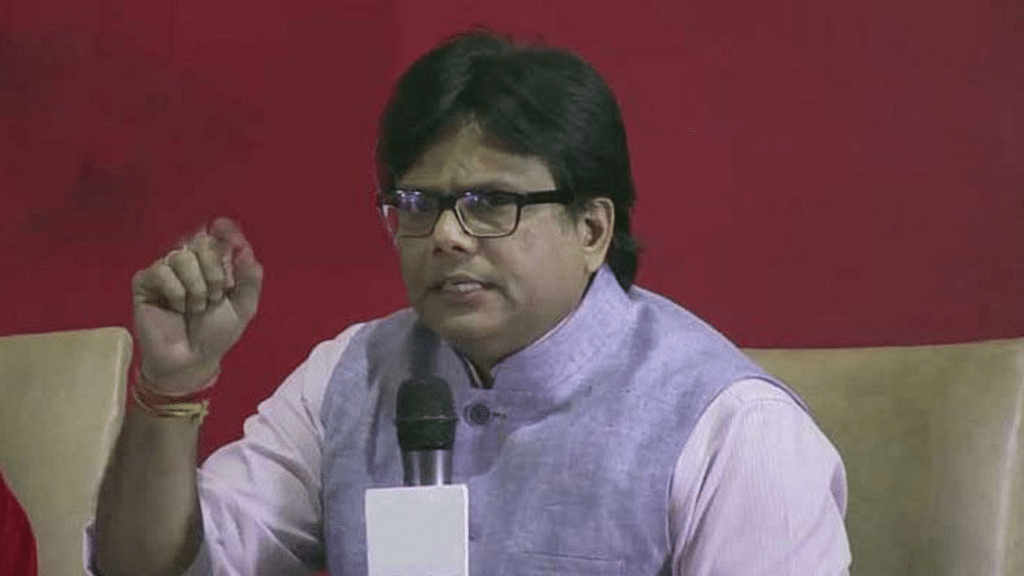
Senior journalist Ashok Shrivastava has recalled an incident from his time at Doordarshan during the 2006–07 UPA regime, claiming that a senior official had asked him to conceal his kalawa the sacred Hindu wrist thread while appearing on a television programme. According to Shrivastava, the official objected to the visible religious symbol on national television and instructed him to hide it during the broadcast. However, he refused to comply with the directive. Recalling his response, Shrivastava said, “This is my identity, this is my pride,” asserting that the kalawa was an important part of his personal and religious identity. The incident, which allegedly took place during his tenure with the public broadcaster, has once again drawn attention after Shrivastava publicly spoke about it. His remarks have reignited discussion around religious expression and institutional attitudes within media organisations during that period.
Smriti Sthal at Brigade parade grounds honours BJP workers

A Smriti Sthal was set up at Brigade Parade Grounds in Kolkata to honour BJP workers who lost their lives in poll-related violence in West Bengal. The memorial was established ahead of a major political event at the historic venue and was dedicated to party supporters whom the BJP describes as victims of political clashes and election-related violence in the state. BJP leaders, workers and supporters visited the memorial site to offer floral tributes and observe moments of silence in remembrance of the deceased party workers. Photographs of the victims were displayed at the venue as part of the tribute. The BJP has repeatedly alleged that the West Bengal government failed to effectively curb political violence, particularly during election periods, and has highlighted the deaths of its workers in clashes across various districts. The issue continues to remain a major political flashpoint in the state, with the party using the Smriti Sthal to reinforce its campaign narrative centred on law and order and alleged political intimidation. The memorial drew considerable attention at Brigade Parade Grounds, where large numbers of BJP supporters gathered ahead of the political programme. Party leaders said the Smriti Sthal was created to honour the sacrifices of BJP workers and to remember those who allegedly lost their lives during political unrest in West Bengal.