
The Population Paradox: We might actually need MORE people!
Population growth has long been one of the most debated issues in public policy, economics, environmental studies, and social sciences. As nations continue to grapple with concerns relating to resource scarcity, environmental degradation, unemployment, poverty, urban congestion, and sustainable development, population control is often presented as a practical solution to many of these challenges. The idea that reducing birth rates can alleviate pressure on natural resources and public infrastructure has gained considerable support among policymakers, environmental advocates, and development planners. However, the issue is far more complex than it initially appears. A proper understanding of population growth requires an examination of the intricate relationship between human beings and the natural environment, as well as the social, economic, and political structures within which populations exist. Human beings are not masters of nature but rather a part of it, and therefore any discussion on population must be situated within the broader context of environmental sustainability, equitable resource distribution, economic development, and human rights. While population growth undoubtedly presents challenges, attributing a wide range of social and ecological problems solely to overpopulation risks oversimplifying a multifaceted issue and may lead to ineffective or even harmful policy responses. The idea of population control is not new. For centuries, scholars and policymakers have debated whether rapid population growth poses a threat to societal stability and economic prosperity. The concern gained prominence through the works of economists who argued that population tends to increase faster than the resources required to sustain it. These theories influenced public policy discussions across the world and encouraged governments to view population growth as a central developmental concern. As a result, several countries adopted policies aimed at reducing fertility rates and limiting population expansion. While some of these policies succeeded in slowing demographic growth, they also generated significant ethical, social, and political controversies. One of the most significant policy experiments undertaken by governments in the modern era has been the attempt to regulate population growth through state-administered measures. The logic behind such policies is relatively straightforward. A rapidly growing population increases the demand for food, housing, healthcare, education, employment opportunities, transportation systems, and public infrastructure. Governments may therefore conclude that controlling population growth is necessary to ensure economic stability and improve living standards. From a purely economic standpoint, slowing population growth may appear to offer several advantages. It can potentially reduce the burden on public services, increase per capita resource availability, and facilitate long-term development planning. Yet, population control is not merely an economic issue. It is also an ethical and social issue that raises important questions regarding personal liberty, reproductive autonomy, and the extent of state intervention in private life. The implementation of stringent population control measures often overlooks the significant role played by education, healthcare access, women’s empowerment, and voluntary family planning initiatives. Numerous studies have demonstrated that fertility rates naturally decline as societies become more educated and economically developed. When women gain access to education and employment opportunities, and when families have access to reliable healthcare and reproductive information, birth rates tend to fall without the need for coercive legal measures. Consequently, before resorting to strict population control laws, governments must consider whether social and economic development itself can achieve the desired demographic outcomes in a more humane and sustainable manner. A central argument often advanced in support of population control legislation is that overpopulation is one of the primary causes of environmental degradation and climate change. According to this perspective, reducing the number of people on the planet would significantly lessen pressure on natural resources and contribute to environmental sustainability. While population growth undoubtedly influences environmental conditions, the relationship between population and ecological degradation is neither simple nor direct. Environmental problems are often the result of specific patterns of production and consumption rather than population numbers alone. Climate change, for example, is driven largely by the excessive burning of fossil fuels, industrial pollution, deforestation, unsustainable agricultural practices, and unregulated economic development. Many of the world’s largest polluters are countries where population growth rates have slowed considerably. Their environmental impact stems primarily from industrial activities, consumer lifestyles, and high levels of resource consumption rather than population size alone. Conversely, several developing countries with large populations contribute relatively little to global greenhouse gas emissions on a per-capita basis. This demonstrates that environmental destruction is not solely a consequence of population size but also of how societies organize their economies and exploit natural resources. The tendency to equate overpopulation with environmental degradation often distracts attention from the structural causes of ecological imbalance. Industrial activities that pollute air, water, and soil frequently operate with inadequate environmental oversight. Large-scale extraction of natural resources, deforestation for commercial purposes, excessive waste generation, and the relentless pursuit of economic growth at the expense of environmental sustainability continue to cause extensive ecological damage. These activities would remain environmentally destructive even in the absence of significant population growth. Therefore, while demographic considerations are relevant, they should not be viewed as a substitute for comprehensive environmental reform. Sustainable development requires a fundamental transformation in the ways societies produce energy, consume resources, and pursue economic growth. Renewable energy technologies, stronger environmental regulations, sustainable agricultural practices, and responsible resource management offer more direct solutions to ecological problems than demographic restrictions alone. Without addressing these underlying issues, population control measures are unlikely to produce meaningful environmental improvements. Another commonly cited justification for population control laws is the perceived scarcity of resources. The assumption is that a growing population inevitably leads to shortages of food, water, housing, and other essential resources. However, evidence suggests that the problem is often less about absolute scarcity and more about distribution and access. Global population growth rates have been declining in many regions due to urbanization, educational advancement, economic development, and increased access to family planning services. At the same time, technological innovations have significantly enhanced humanity’s ability to produce food and other necessities. Advances in agricultural science, irrigation systems, transportation networks, food preservation techniques, and biotechnology have expanded production capacities to levels unimaginable in
Shivrajyabhishek and the Rebirth of a Nation
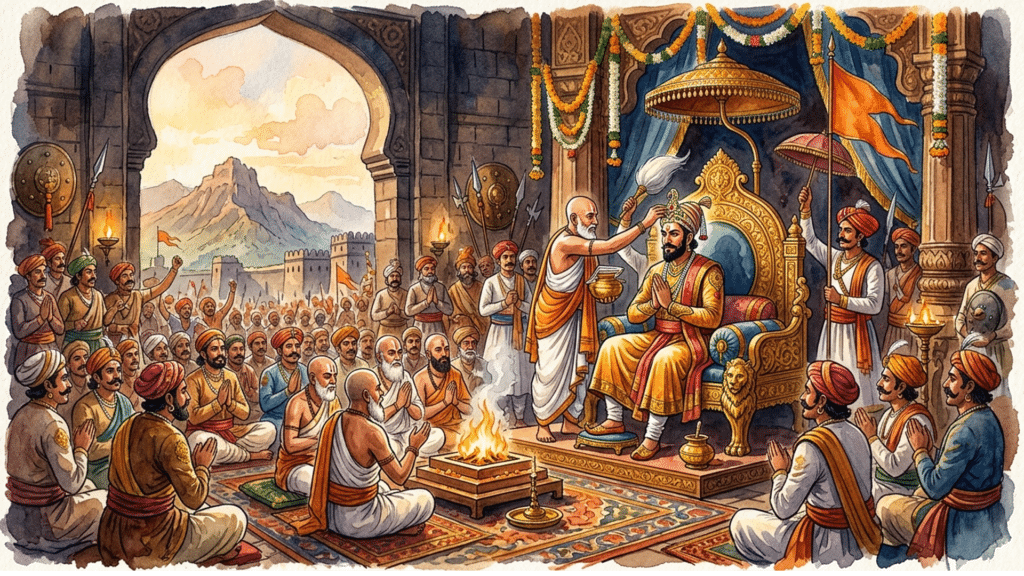
On 6 June 1674, atop the rugged heights of Raigad, a ceremony unfolded that would alter the course of Indian history. To many, it was the coronation of a regional king. To those who understood the currents of the age, it was something far greater. It was the return of a civilisation to political self-awareness. The Rajyabhishek of Chhatrapati Shivaji Maharaj was not merely the crowning of a ruler. It was the coronation of an idea. To millions across Bharat, both then and now, it represented something far greater. It was the formal proclamation of a civilisational resurgence. It was the day a conquered people remembered that they were destined to govern themselves. It was the day Hindavi Swarajya ceased to be a dream and became a political reality. It was the restoration of confidence to a civilisation that had endured centuries of invasion, occupation, and humiliation. It was the moment when the darkness that had long enveloped large parts of India first began to recede before the light of freedom. For nearly five centuries before Shivaji’s rise, the political landscape of India had been transformed by successive waves of foreign conquest. Great temples had fallen. Ancient dynasties had disappeared. Cities had been plundered. Idols of Gods were broken down. The symbols of indigenous sovereignty had steadily diminished. While resistance never ceased—from the Rajputs in the north to the Vijayanagara Empire in the south—the broader reality remained unchanged. Much of the subcontinent lived under powers that neither emerged from nor represented the civilisational ethos of Bharat. By the seventeenth century, the Mughal Empire appeared invincible. Under Aurangzeb, it possessed enormous wealth, vast armies, and the resources of a continent-spanning state. Imperial authority stretched from Kabul to Bengal and from Kashmir deep into the Deccan. To many observers, Mughal dominance seemed permanent. Yet history often changes not through the calculations of empires but through the conviction of extraordinary individuals. Shivaji Maharaj was one such individual. Born in 1630 amidst political uncertainty and military conflict, Shivaji inherited neither a vast kingdom nor an established throne. What he inherited was an idea. Guided by the teachings of his mother Jijabai and inspired by the heroes of India’s civilisational past, he envisioned something that few dared to imagine: self-rule. Not merely power for himself. Not merely territorial expansion. But Swarajya. The word carried profound meaning. It was the assertion that the people of the land had the right to govern themselves according to their own traditions, values, and aspirations. It was the rejection of subordination. It was the restoration of dignity. What made Shivaji remarkable was that he transformed this vision into reality. Fort by fort, campaign by campaign, alliance by alliance, he built a state where none had existed before. He challenged the Adilshahis, the Qutb Shahis, and ultimately the Mughals. He demonstrated that imperial power could be resisted and defeated. More importantly, he demonstrated that political legitimacy did not flow from Delhi or any imperial capital. It could emerge from the soil of Bharat itself. Yet even after decades of military success, something remained incomplete. A kingdom existed. A ruler existed. But the deeper symbolism of sovereignty still awaited formal recognition. The Rajyabhishek would change that. The coronation at Raigad was carefully conceived and meticulously executed. Scholars were invited from across India. Rituals rooted in ancient Hindu statecraft were revived. Sacred waters from holy rivers were gathered. The ceremonies affirmed not merely Shivaji’s authority but the continuity of India’s civilisational traditions. The significance of this cannot be overstated. For centuries, many indigenous rulers had governed as local powers within larger imperial frameworks. Shivaji’s coronation declared something fundamentally different. He was not seeking legitimacy from any foreign court. He was not ruling by the permission of an emperor. He was asserting sovereign authority in his own right. The title he assumed reflected this confidence. Chhatrapati. Lord of the royal umbrella. Protector of the realm. Defender of the people. The coronation transformed a successful warrior into a civilisational symbol. For countless Hindus living under various forms of foreign domination, the event carried immense psychological significance. It demonstrated that history was not moving in only one direction. The age of conquest could be challenged. The age of submission could end. The Rajyabhishek was therefore more than a political ceremony. It was an act of civilisational remembrance. It reminded a wounded society that it possessed its own political traditions. Its own concepts of kingship. Its own standards of legitimacy. Its own vision of statecraft. The chants that echoed through Raigad that day were not merely ritual sounds. They were declarations that an ancient civilisation remained alive. The light that emerged from Raigad did not remain confined to the Sahyadri mountains. Its radiance spread across India. Within a generation of Shivaji Maharaj’s passing, the Marathas would become the foremost power challenging Mughal supremacy. By the eighteenth century, Mughal authority had been reduced to a shadow of its former self. The empire that once seemed eternal steadily disintegrated. Maratha armies rode across the subcontinent. Their influence extended from the Deccan to Delhi, from Gujarat to Odisha, from Malwa to Tamil lands. The saffron standard flew where imperial authority had once appeared unquestionable. This transformation did not occur by accident. Its origins lay in the confidence created by Shivaji’s example. The Rajyabhishek had provided more than a king. It had provided a template. It showed future generations that indigenous political power could not only survive but triumph. Indeed, many later movements for freedom in India would draw inspiration from Shivaji Maharaj. Nationalists of the nineteenth and twentieth centuries invoked his name with reverence. Revolutionaries celebrated his courage. Thinkers admired his statecraft. Reformers praised his commitment to justice. Across ideological lines, Indians recognised in Shivaji a figure who embodied resistance, self-respect, and national awakening. His relevance endures because the principles he championed transcend his era. Shivaji Maharaj believed that political freedom and cultural confidence were inseparable. He understood that sovereignty was not merely about territory but about preserving a
CJP protestor at Jantar Mantar raise ‘Godi Media’ slogans

Youth protesters raised slogans against what they described as “Godi Media” during a CJP-led demonstration at Jantar Mantar on Saturday. Participants gathered at the protest site to voice their demands and express their views on various issues. Several demonstrators chanted slogans criticizing sections of the media, alleging bias in news coverage. Protesters also displayed placards and banners highlighting their concerns and seeking greater public attention to the matters they were raising. The protest saw the participation of a large number of young people. Organizers addressed the gathering, outlining their demands and the objectives of the demonstration. Speakers throughout the event stressed the importance of civic engagement and the peaceful expression of opinions. They encouraged participants to continue raising their concerns through democratic means. Security personnel were deployed at the venue to maintain law and order and monitor the situation. The demonstration remained largely peaceful as protesters continued their activities under police supervision. Jantar Mantar, a designated venue for public demonstrations in the national capital, has long served as a platform for groups seeking to draw attention to social, political, and economic issues. The CJP-led protest was among several recent demonstrations organized by youth and civil society groups in the city.
Oil India discovers natural gas in Andaman offshore block

India has received a significant boost in its offshore energy exploration efforts after Oil India Limited (OIL) confirmed the presence of natural gas at the Sri Vijayapuram-3 exploratory well in the Andaman offshore basin. The discovery marks the second successful hydrocarbon find among the three wells drilled by the company in the region, highlighting the growing potential of the Andaman Basin as an important energy resource area. The Sri Vijayapuram-3 well is located about 15 kilometres off the eastern coast of the Andaman Islands in waters approximately 355 metres deep. Initial testing confirmed the presence of gas-bearing zones, strengthening confidence in the basin’s hydrocarbon prospects and building on earlier discoveries in the area. Union Minister for Petroleum and Natural Gas, Hardeep Singh Puri, welcomed the development, describing it as a major step forward in India’s efforts to expand domestic energy production. He said the discovery reinforces the vast opportunities available in the country’s offshore regions and supports the goal of achieving greater energy self-reliance. The find is also seen as a key milestone under the government’s Samudra Manthan Mission, an initiative aimed at accelerating offshore exploration and unlocking untapped energy resources in India’s maritime zones. Experts believe continued success in the Andaman Basin could help reduce India’s dependence on imported oil and natural gas, although further appraisal, infrastructure development, and regulatory approvals will be required before commercial production can begin. With hydrocarbons now confirmed in two of the three exploratory wells drilled in the region, the Andaman offshore basin is increasingly emerging as a promising destination for future exploration and investment. Industry observers say sustained discoveries could strengthen India’s long-term energy security, support economic growth, and play an important role in meeting the country’s rising energy demand.