
The Man Behind Alzheimer’s Disease: Dr. Alois Alzheimer
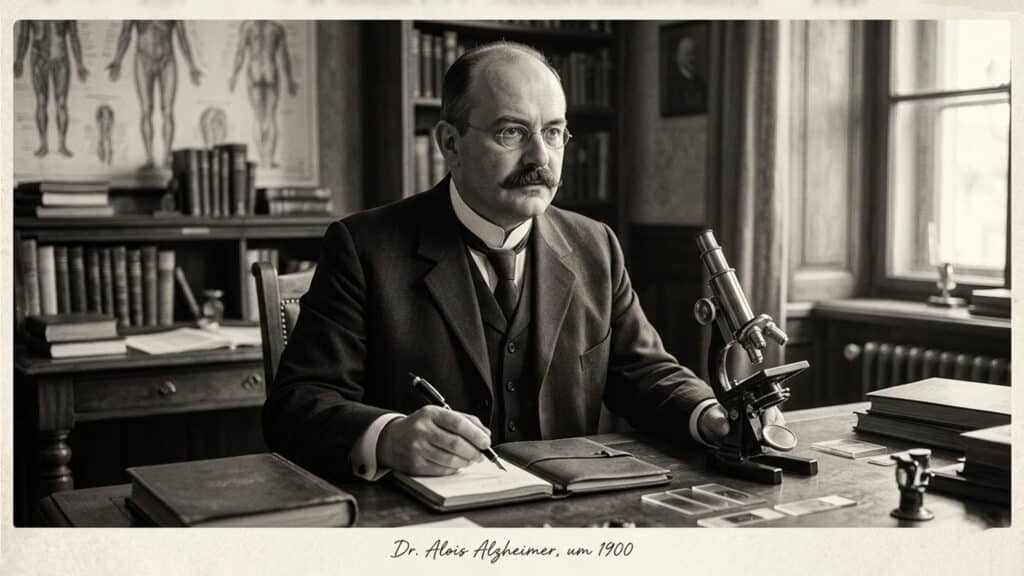
The name “Alzheimer” is globally recognized as a definitive medical designation a word that instantly evokes cognitive decline, faded memories, and the slow, heartbreaking dissolution of the self. Yet, behind this monumental medical label was a living, breathing human being: Dr. Alois Alzheimer. While history books celebrate him as a founding father of modern neuropathology, his personal life was a complex tapestry of profound grief, domestic duty, financial vulnerability, and a relentless work ethic used as a shield against emotional devastation.To fully understand the discovery of Alzheimer’s disease, one must look beyond the clinical microscope and examine the quiet, bittersweet personal struggles of the man who wielded it. Early Life and the Weight of Family Duty Aloysius “Alois” Alzheimer was born on June 14, 1864, in the small, picturesque Bavarian town of Marktbreit-am-Main, Germany. Raised in a devoutly Catholic household, his early life was shaped by an environment where duty, order, and intellectual rigor were paramount. His father, Eduard Alzheimer, served as a local notary public, a position demanding absolute precision and trustworthiness traits that Alois would mirror deeply in his later scientific pursuits.However, the Alzheimer home was also intimately familiar with domestic disruption and loss. Eduard’s first wife passed away at a young age. He then married her sister, Theresia Busch, who became Alois’s mother. Tragically, Theresia also passed away during Alois’s youth, forcing his father to marry a third time to Marta Katharina Maria Geiger. Growing up in a massive, blended family of eight children, Alois learned early to navigate a crowded household marked by recurring maternal loss and the necessity of personal resilience.Recognizing their son’s sharp scientific aptitude, the family relocated to Aschaffenburg so Alois could attend the prestigious Royal Humanistic Gymnasium. After completing his secondary education in 1883, he embarked on an extensive medical journey, studying at the universities of Berlin, Tübingen, and Würzburg. Alois was not a rigid, somber academic in his youth; he joined a fencing fraternity and was even fined for disturbing the peace during a boisterous night out with his team. Yet beneath this youthful energy was an incredibly meticulous scientist. In 1887, he graduated from Würzburg as a Doctor of Medicine, writing a highly detailed doctoral thesis on the ceruminous glands of the ear.Despite his academic success, entering the professional world brought immediate financial vulnerability. As a young doctor drawn to the nascent and misunderstood field of psychiatry, secure, high-paying positions were scarce. To make ends meet and gain clinical exposure, he agreed to serve as a traveling personal physician for a mentally ill woman, spending five grueling months at sea. This isolating experience solidified his empathy for psychiatric patients and permanently directed his focus toward the mysteries of the human brain. The Frankfurt Asylum and the Anchor of Marriage In December 1888, the 24-year-old Alzheimer accepted a position as a resident assistant physician at the Municipal Asylum for Lunatics and Epileptics in Frankfurt am Main. Colloquially known as “The Asylum,” the institution was led by the progressive psychiatrist Emil Sioli, who championed humane patient care over chemical or physical restraint. Here, Alzheimer found a professional sanctuary, but the financial reality of research remained a constant burden. Nineteenth-century psychiatry was poorly funded, and conducting laboratory work required personal investments in expensive microscopes, tissue stains, and preservation tools.During these early years in Frankfurt, Alzheimer formed an enduring friendship with fellow physician Franz Nissl. Together, they formed an exceptional scientific team. Nissl invented revolutionary cellular staining methods, while Alzheimer possessed the methodical patience to apply them across thousands of tissue samples. However, running a cutting-edge histopathological laboratory on an assistant clinician’s meager salary was an unsustainable struggle.This precarious economic situation changed dramatically in the early 1890s when Alzheimer took over the medical care of Cecilie Simonette Nathalie Geisenheimer. Cecilie was the 33-year-old widow of a highly successful diamond merchant. A mutual affection grew between the caring physician and his patient, culminating in their marriage in April 1894.For a brief period, Alzheimer’s life experienced an influx of stability and profound joy. Cecilie brought immense financial independence to the marriage, which she gladly used to fund her husband’s lifelong passion. Her wealth allowed Alzheimer to buy the finest laboratory equipment, pay for his own research costs, and work without the looming anxiety of poverty. Together, they built a vibrant home and welcomed three children into the world: Gertrud, Hans, and Maria. For seven years, Cecilie was his emotional anchor, enabling him to balance the heavy emotional toll of the asylum with a warm, supportive domestic life. Shattered Peace: Grief as a Catalyst for Obsession The fragile peace of Alzheimer’s personal life shattered on February 28, 1901, when Cecilie died suddenly at the age of 41.The loss plunged the 36-year-old physician into profound grief. Left alone with three young children all under the age of six Alzheimer faced a devastating domestic crisis. He had to balance the demands of a rigorous medical career with the sudden, overwhelming responsibilities of a single father. Choosing never to remarry, he internalized his heartbreak.To survive the crushing weight of his sorrow, Alzheimer turned to the only sanctuary he had left: his laboratory. His commitment to neuropathology mutated into a deep obsession. He became a relentless workaholic, spending days at the asylum and working late into the night, using the precision of the microscope to avoid confronting his empty home. His close friend Franz Nissl observed this painful transition, later describing Alzheimer as a man “filled with burning enthusiasm” who used exhausting, methodical laboratory work as a shield against his personal tragedy.It was during this dark, grief-stricken year of 1901 that a new patient arrived at the Frankfurt Asylum a 51-year-old woman whose story would intertwine with Alzheimer’s forever. Her name was Auguste Deter. Auguste Deter: A Shared Fight Against Shadows When Auguste Deter was admitted to the Frankfurt facility on November 25, 1901, she was suffering from severe disorientation, memory loss, hallucinations, and rapid cognitive decline. Her husband, entirely overwhelmed by her erratic behavior, could no longer care for