
The Woman Who Taught the World to See
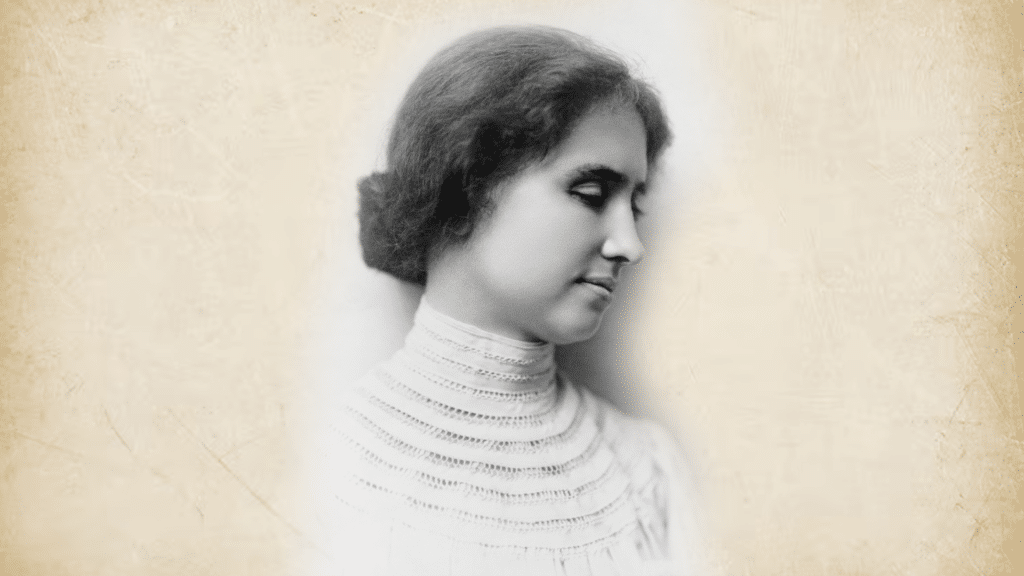
There is a version of Helen Keller that most of us learned in school. A small girl in a garden in Alabama, water running over one hand, a teacher spelling letters into the other, a single moment of breakthrough that changed everything. It is a beautiful story. It is also, in almost every meaningful sense, incomplete. Helen Adams Keller was born on June 27, 1880, in Tuscumbia, Alabama and the story most of us inherited about her life is not quite the one she actually lived. It seems worth setting aside the sanitised legend, the miraculous child, the triumph over adversity, the tidy Hollywood ending and reckoning seriously with who she actually was. Because the real Helen Keller was far more interesting, far more radical, and far more instructive than the version we were given. The Darkness Before the Word Keller lost both her sight and hearing at just 19 months old. She contracted an illness called “brain fever” by the family doctor that produced a high body temperature. The true nature of the illness remains a mystery today, though some experts believe it might have been scarlet fever or meningitis. What followed was a childhood of profound isolation. Helen was quite intelligent and tried to learn in her own way with taste, feel and smell. She developed a rudimentary sign language with which to communicate, but soon she realized that her family members could communicate with their mouths instead of signing. This left her isolated, unruly and prone to wild tantrums. Some members of her family considered institutionalizing her. She was not a passive child waiting to be rescued. She was a furious, intelligent person trapped inside a communication barrier she could sense but not breach. There is something important in that distinction. Keller herself would later write that the need to communicate had become so urgent that her outbursts occurred daily, sometimes hourly. This was not a child without a mind. This was a mind in desperate search of a language. Seeking to improve her condition, Helen and her parents travelled from their Alabama home to Baltimore, Maryland, to see an oculist. After examining Keller, he told her parents that he could not restore her sight, but suggested that she could still be educated, referring them to Alexander Graham Bell, who was working with deaf children in Washington, D.C. Bell connected the Kellers to the Perkins Institute, and by March 1887, Anne Sullivan came to Ivy Green to be Helen’s teacher. The Miracle, and What It Actually Meant Sullivan arrived at Keller’s house on March 5, 1887, a day Keller would forever remember as “my soul’s birthday”. Sullivan immediately began to teach Helen to communicate by spelling words into her hand, beginning with “d-o-l-l.” The breakthrough of that famous moment at the water pump came weeks later. Keller understood suddenly that everything had a name, that the letters Sullivan pressed into her palm were not arbitrary gestures but symbols pointing outward at the world. It was not simply the discovery of a word. It was the discovery of language itself. Of the fact that reality could be named, shared, transmitted. The popular imagination tends to stop here. A miracle happened. The child was saved. Roll credits. But Anne Sullivan did not leave after the water pump moment. She stayed for nearly fifty years. Sullivan was Keller’s constant companion at home and on lecture tours until Sullivan’s death in 1936. That is not the arc of a rescue story. That is the arc of a life built painstakingly, collaboratively, and without end. The Education No One Expected What Keller did after that moment in the garden is the part of the story that deserves far more attention than it typically receives. After an education at both specialist and mainstream schools, Keller attended Radcliffe College of Harvard University and became the first deafblind person in the United States to earn a college diploma. She graduated cum laude in 1904. Consider what that required. Every lecture had to be interpreted into her hand. Every book had to be read in Braille or spelled out to her. Every examination sat in real time, with Sullivan beside her translating the questions and recording the answers. The intellectual stamina this demanded is almost impossible to fully comprehend. She learned to read lips by placing her fingers on the face of the speaker, feeling the vibrations of the throat, the movement of the mouth. She learned, eventually, to speak aloud, though the effort required years and the results were difficult for many listeners to understand. She gave lectures regardless. She did not wait for conditions to become more favourable. She travelled to over 25 countries and gave speeches about the conditions of deaf people and the issues they go through on a daily basis. This was not a woman who had found her miracle and retired to comfort. She was permanently, restlessly in motion. The Radical Nobody Mentions Here is the part of the story that most school curricula quietly omit. Helen Keller was a socialist. She was a suffragist. She was a co-founder of the American Civil Liberties Union. She opposed the First World War at a time when doing so was genuinely dangerous. She championed birth control, labour rights, and racial equality decades before any of these causes achieved mainstream respectability. Keller campaigned for those with disabilities and for women’s suffrage, labor rights, and world peace. She was not a gentle inspirational figure who smiled through adversity and asked for nothing in return. She was a woman with firm political convictions who used her extraordinary public platform to argue for structural change, and who was willing to be unpopular in doing so. In 1920, she helped found the American Civil Liberties Union. That institution has spent over a century defending civil liberties in America’s courts. Her fingerprints are on it. The Helen Keller story that is stamped in our collective consciousness freezes her in childhood. The books we give children recount only