
Why Children Should Never Eat Eggs Again
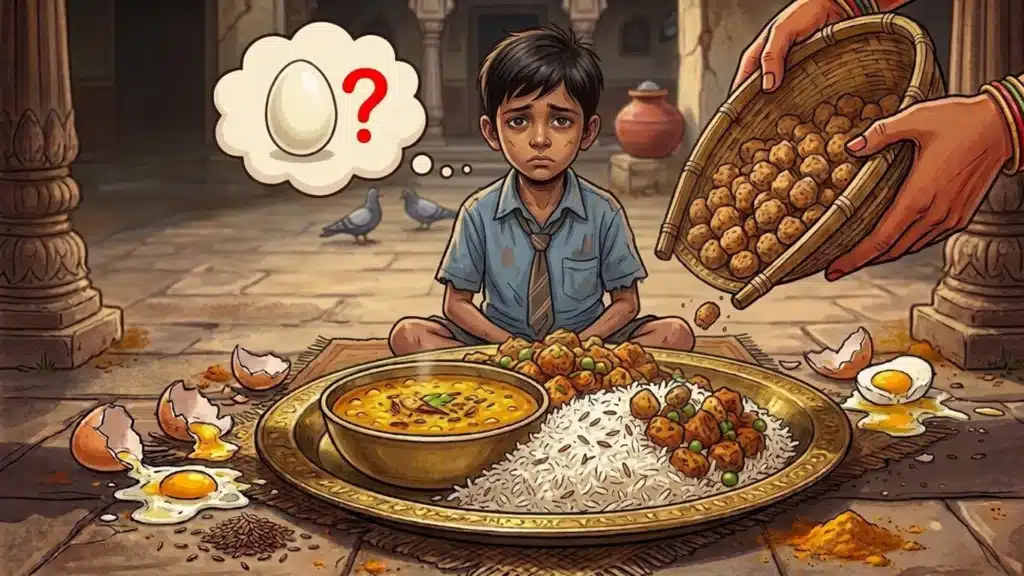
A Modest Proposal for India’s Greatest Nutritional Crisis (Satire) Breaking news. Scientists have finally discovered the single greatest threat facing Indian schoolchildren. Not stunting. Not anaemia. Not protein deficiency. Not the fact that millions of children still depend on a single school meal as their most reliable source of nutrition. No. The real enemy… …is an egg. For decades, nutritionists across the world have been fooled into believing that eggs are one of the cheapest, most nutrient-dense foods available. Thankfully, social media has finally corrected them. Why listen to decades of nutritional science when you can win an argument with a screenshot saying, “100 grams of soya has 36 grams of protein while eggs have only 13”? Case closed. Pack it up, science. Let’s imagine a government school. A child walks in after skipping breakfast because there wasn’t enough food at home. Lunch is probably the only proper meal they’ll eat today. Yesterday there was an egg. Today there isn’t. And the nation breathes a collective sigh of relief. One more child has been saved from… complete protein. You see, nutrition is actually very simple. Open Google. Search “protein per 100 grams.” Find the biggest number. Declare victory. Who cares whether anyone actually eats 100 grams of dry soybeans? Who cares whether they’re cooked? Who cares whether the body digests and absorbs those proteins differently? Those are details. Nutrition should never be complicated by biology. Scientists often use words like bioavailability, digestibility, essential amino acids, PDCAAS and DIAAS. Honestly? They sound like excuses invented by the CIA-funded “egg lobby”. Fortunately, WhatsApp University has simplified everything. Protein is protein. A gram is a gram. And therefore ₹500 in crisp notes is exactly the same as ₹500 in one-rupee coins. Please don’t ask anyone to carry the coins. Unfortunately, the human body refuses to cooperate with this elegant theory. It stubbornly insists on digesting proteins differently. How inconvenient. A review published in the journal Nutrients points out that animal proteins—including eggs—generally score higher on protein quality because a greater proportion of their essential amino acids are absorbed and used by the body. But clearly those researchers forgot one crucial scientific principle: Screenshots don’t lie. Nutritionists keep repeating annoying facts. They say one egg contains around six to seven grams of complete, highly digestible protein. They point out that eggs contain all nine essential amino acids. They explain that plant proteins are excellent too—but often need thoughtful combinations such as dal with rice or pulses with dairy to achieve a similarly balanced amino acid profile. How tiresome. Wouldn’t it be much easier to pretend every protein behaves identically? Think about the possibilities. Instead of giving a child one egg… …we could simply hand them a nutrition textbook. Page one: “Dear child, please ensure your lysine and methionine intake is balanced by combining complementary proteins throughout the day.” Problem solved. “But children don’t have balanced diets at home.” Exactly. That’s why we’ll simply ask them to have one. Let’s take this logic a little further. Doctors often recommend complete proteins for growing children. Clearly they’re underestimating the motivational power of optimism. If a child believes hard enough… …their amino acids will arrange themselves. Then comes another brilliant proposal. “Just give them more dal.” Excellent idea. Dal is wonderful. India absolutely should eat more pulses. But let’s quietly skip the awkward part. Dal isn’t just protein. It’s also carbohydrate and fibre. To obtain comparable amounts of high-quality protein, children may need substantially larger servings. Fortunately, every six-year-old has the appetite of a construction worker. Not enough? No problem. We’ll replace the egg with paneer. Simple. Except… Paneer needs refrigeration. Paneer spoils. Milk products require careful handling. Food safety authorities have repeatedly found adulteration in dairy products across different markets. Minor inconvenience. Nothing builds character like wondering whether today’s paneer contains more milk or more detergent. Or perhaps… Let’s just give every child two litres of milk. After all, someone on the internet said that’s what wrestlers drink. Never mind that dietary habits differ across regions. Never mind lactose intolerance. Never mind affordability. Every child shall now become a heavyweight athlete. Speaking of athletes… Ladies and gentlemen… The Virat Kohli Argument. This deserves a standing ovation. “Virat Kohli is vegetarian.” Yes. He is. And therefore every government school nutrition programme should obviously copy Virat Kohli. This makes perfect sense. Virat Kohli has absolutely nothing that government schoolchildren don’t. No personal chef. No sports nutritionist. No recovery specialist. No physiotherapist. No sports physician. No regular blood tests. No customised supplementation. No performance diet. Nothing at all. His life is basically identical to that of a child whose school lunch may be their only proper meal of the day. Imagine Virat waking up. His nutrition team reviews blood markers. Adjusts micronutrients. Monitors protein intake. Changes the menu based on training load. Now imagine Raju in Class Four. He hopes today’s dal isn’t watery. Clearly these are identical situations. It’s like saying, “Why build government hospitals? Mukesh Ambani doesn’t use them.” Or, “Why improve public transport? Max Verstappen does’t take buses.” The comparison is so spectacularly irrelevant that it deserves preservation in a museum. Now let’s move to morality. Because no Indian debate is complete until food becomes philosophy. Some people sincerely believe vegetarianism is the more compassionate ethical choice. That’s a legitimate moral position. Many people genuinely hold it. Others have different traditions. India has always accommodated both. Which is precisely why turning one dietary ethic into a universal public policy becomes complicated. India doesn’t have one food culture. It has hundreds. In large parts of Bengal, Assam, Odisha, Kerala and much of the Northeast, eggs are simply food. Not politics. Not identity. Not ideology. Just… breakfast. So whose ethics should define a public nutrition programme? The vegetarian grandmother from Jaipur? Or the fisherman from coastal Bengal? Or the tribal family in Assam? Or the household in Kerala where eggs are entirely ordinary? The answer is probably none of them. Because governments don’t exist to settle theological
India reopens tourist visa services in B’desh after nearly 2 years

India has restarted tourist visa services for citizens of Bangladesh after a gap of nearly two years, marking an important step towards improving travel connectivity and people-to-people ties between the two neighbouring countries. The tourist visa facility had remained suspended for a considerable period due to diplomatic challenges and other operational issues. With the resumption of services, Bangladeshi citizens can now apply for Indian tourist visas through designated visa application centres in Bangladesh. The move is expected to benefit a large number of travellers from Bangladesh who visit India for tourism, meeting family members, medical purposes, and other personal reasons. India and Bangladesh share deep historical, cultural, and social connections, with regular movement of people between the two nations. The reopening of tourist visas is likely to make travel easier and help revive tourism and related sectors that were affected due to restrictions on visa services. Officials said the decision would provide greater convenience for Bangladeshi travellers and support stronger exchanges between the people of both countries.