
Assam’s Flood Crisis: What Keeps Going Wrong?
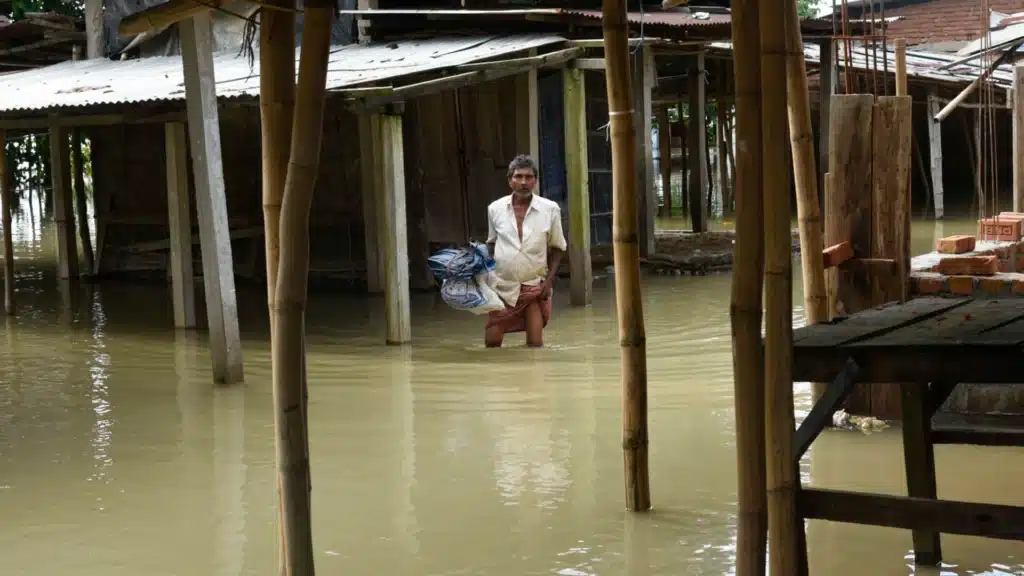
Assam’s floods struck again in July 2026, and once again the scale was devastating. Floodwater filled homes overnight, submerging bedrooms in knee-deep mud within hours. Bamboo houses collapsed into the current, and families fled with whatever they could carry. By morning, thousands of displaced people lined the state’s elevated highways. They set up makeshift shelters, stretching plastic tarpaulins over bamboo poles for cover. Many camped alongside stranded livestock, sharing the same dry patches of road. The air carried the smell of wet silt and sewage for days. In July 2026, a sudden cloudburst upstream triggered catastrophic flood waves across Assam. The water arrived with speed that left families almost no time to flee. Over seventy five people died as rivers overflowed across major districts.Strangely, this wave did not come from the Brahmaputra itself overflowing. Heavy rain fell upstream in Nagaland and Arunachal Pradesh instead. That rain sent smaller south-bank rivers, like the Dikhou and Disang, rising fast. This was also not even the year’s first flood. Assam had already survived one deadly wave back in June. Families barely finished rebuilding before the water returned. Upstream surges left over seven hundred thousand residents affected within days. Historically safe Upper Assam districts like Sivasagar and Charaideo flooded, catching families off guard.Submerged crops wiped out the financial security of countless small farming families. Air Force helicopters dropped basic food rations to villages cut off by water. This kind of disaster is not new for Assam, and it is not unexpected. It has become an annual routine of loss and rebuilding across generations.Every monsoon, people rebuild their homes from mud and debris. Every monsoon, the Brahmaputra comes back and takes it all away again. If this happens every single year, the real question is why Assam still isn’t prepared. Why Assam Can Never Escape the Water Assam’s unique topography makes seasonal flooding an inevitable geographical reality. The state sits tightly inside a narrow, bowl-shaped tropical valley.High Himalayan mountain ranges surround the fertile lowland region on all sides. Powerful mountain streams carry massive water volumes down into Assam daily. The mighty Brahmaputra River acts as the main hydrological spine of the state. Over fifty major tributaries feed directly into this massive central channel. During summer monsoons, heavy clouds drop immense rainfall across catchment zones. The river channel simply lacks the capacity to hold that volume.High velocity currents rush downstream through narrow valleys, collecting immense kinetic energy. When these streams reach Assam’s flat plains, water spreads across thousands of square kilometers.Centuries ago, Indigenous communities viewed these seasonal overflows as natural, life giving gifts. Floodwaters deposited nutrient rich silt across agricultural fields every single year. Farmers adapted their traditional stilt housing, called Chang Ghar, along with their planting calendars. Modern infrastructure and rapid population growth eventually broke that delicate ecological balance. What was once a harmonious natural cycle turned into a recurring human crisis. How History Reshaped the Brahmaputra Historical records show Assam always lived alongside these rising seasonal waters. British colonial officers documented severe regional flooding throughout the nineteenth century.Imperial administrators built early mud embankments to shield commercial tea plantations. Yet natural wetlands absorbed most excess runoff without major human displacement. A catastrophic tectonic event altered the region’s geography forever on August 15, 1950. A massive magnitude 8.6 earthquake shook the entire Brahmaputra valley violently.The shock triggered massive landslides across fragile Himalayan mountain slopes. Millions of tons of rock, timber, and soil collapsed into major river channels.This debris permanently raised riverbeds and destroyed heritage sites like Majuli Island. As the world’s largest inhabited river island, Majuli lost over half its landmass. Ancient Neo-Vaishnavite monasteries, known as Satras, housing priceless art vanished into the currents. The 1950 earthquake turned a natural ecological cycle into a perpetual human emergency. Subsequent decades brought more tectonic instability along active fault lines across Northeast India. Micro-seismic activity keeps altering riverbed slopes and shifting tributary paths every few years. The Science Behind Assam’s Floods Understanding why modern engineering fails requires looking at the river’s complex shape. The Brahmaputra is a vast, interconnected braided river system with extreme instability. Rather than flowing through one channel, it splits into dozens of sub-channels. These shifting streams continuously cross, abandon, and carve new routes during high flows.The river carries over six hundred million metric tons of sediment annually. As mountain streams hit flat plains, current velocity drops rapidly. Coarse, sterile sand settles directly on fields instead of fertile organic topsoil. Uncompacted sand banks undergo rapid liquefaction and collapse, swallowing entire villages overnight. Assam relies heavily on over four thousand kilometers of outdated earthen dikes. These mud structures fail through piping, sand boils, and sudden overtopping.Water seeps through porous bases, creating underground channels that collapse the embankment walls. When dikes breach, contained waters burst through like inland tsunamis. This year offered a sharp reminder of that fragility firsthand. Ten embankments were damaged statewide during the July wave alone. Seven of those breaches happened in Sivasagar district by itself. Hydrodynamic pressure against these aging mud structures grows stronger every passing decade. Heavy silt deposition combined with structural decay renders old embankment engineering essentially obsolete. The Cost of Unplanned Growth Recent years brought a massive surge in infrastructure development across Assam. Paved highways, railway lines, and housing corridors now cross the entire valley. While these projects boost connectivity, they disrupt natural drainage landscapes severely. Unplanned road embankments often act as artificial dams, trapping floodwaters for months.Urban centers like Guwahati show the dark side of uncontrolled concrete expansion. Critical wetlands like Deepor Beel have shrunk dramatically from illegal encroachment. Concrete construction seals the topsoil completely, preventing natural storm water absorption during downpours. Stripped hill slopes send massive silt loads directly into city drainage networks daily.When intense monsoon cloudbursts arrive, urban stormwater has nowhere to flow. Cities suffer artificial flooding, trapping residents in waterlogged neighborhoods for days. Municipal drains choke within minutes under the weight of uncollected waste and silt. Concrete expansion continues outpacing urban drainage planning across every major Assamese municipality. Local groups have begun pointing fingers at another
CJP Protests: Who Decides Who Will Be Punished?
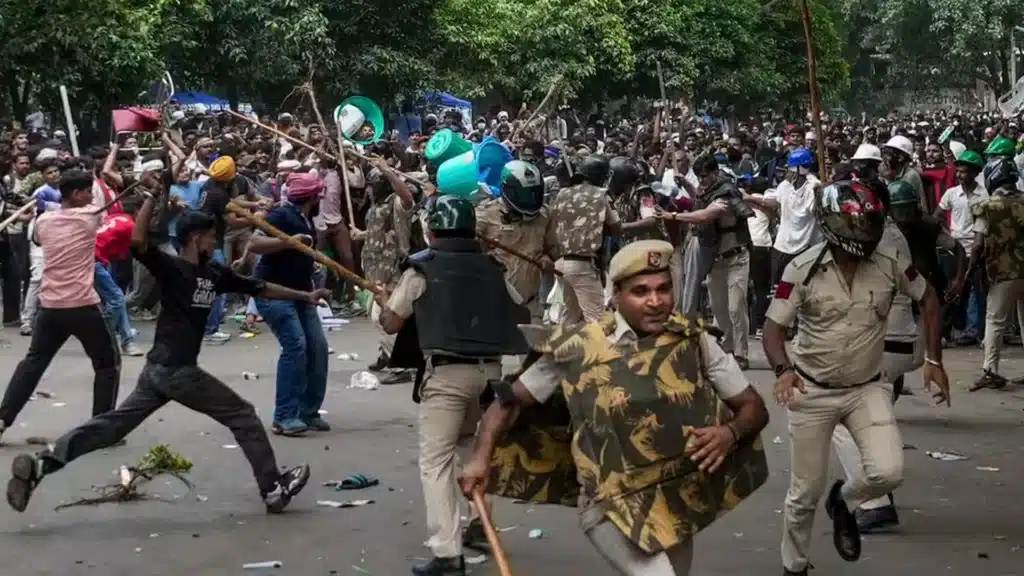
The alleged agreement between CJP and the State has given rise to a new moral and legal problem. The background of the protests is well known to everyone at this point. However, the latest problem it has created, is pretty novel. The Problem! Imagine this. You’re a Police Officer. There is a clear direction – you have to be on field on 20th of July at Delhi. The State has entrusted an official duty onto you. The clear instruction is this – maintain Law and Order, no matter what! However, circumstances changed for the worse out of nowhere. The protests have turned violent. Suddenly, what was supposed to be a peaceful student-led protest, has turned into an all-out brawl. Your biggest enemy is the fact that you are wearing a symbol of the State – your official uniform! Stones are being thrown at you, and a mob has rushed to lynch you. On that day, you are representing the enemy. You represent the very people who have wronged the young students of this country. Needless to say, the State has committed its fair share of wrongs in this entire situation, and today, you’re directly facing the brunt of it. The legitimacy of these protests, and the consequent police brutality has been the focal point of much discussion. Some have argued, that the Students should have engaged in the movement while upholding constitutional democracy, and rejecting violence and manipulation. However, the other side has inevitably argued that the degree of aggression meted out against mere Students was unjustified. However – one fact remains undisputed. There was violence, and consequently, injuries. Consequences! Thankfully, by the end of the day, the dust has settled, and the protests are finally under control. However, there are consequences for you. You are left battling with several bodily injuries while you were carrying out your official duties under the instructions of the State. However, there is another twist in the tale! Despite the fact that you’re the one who was the victim of stone pelting, despite the fact that you’re the one who has gotten beaten up and injured, you are told that you won’t get to decide if your aggressors get punished. The very authority that you represented, the one that directly led to your sorry condition, has refused to stand behind you. Allegedly, a deal has been cracked with the agitators. The declaration is clear – No First Information Reports (FIRs) to be pursued against any of the protestors. You sit in the Hospital, wondering – what is your fate now? Who is standing with you? Will your injuries be for nothing? Now, all these events have led to a bigger moral and legal question. When you were the one who was injured, and naturally, you will be the one who will have to bear the brunt of the said injuries, who decides the fate of your case? Whether the State can, on your behalf, just declare that nobody will be punished for throwing stones at you and nobody will be held responsible for beating you black and blue? Are your injuries supposed to be mere collateral damage, which the State can write-off for a political deal to save their skin? Even if the same set of events are looked at from the perspective of the students present on ground, the Legal problem remains constant. Whether a blanket demand for no coercive action against any protestor be legally, or even morally tenable? Furthermore, if a blanket protection is given to anybody and everybody who claimed to be standing with the students on that date, will it logically not lead to a blanket protection for all genuine officials who, indeed, were responsible for the Police Brutality meted out on the 20th of July? The Law is otherwise clear. If an offence is committed, the Due process of Law must be followed. The argument extends both ways. The aggressors on the streets must answer for their crimes. The Law cannot, and absolutely must not differentiate between the criminal. A person who has broken the law, must be dealt with, as per Due Process of Law. The law must be blind as to the identity of who has broken the law – It must be immaterial if the criminal is a student, or the Police. A blanket protection from any coercive order for ALL the people representing the protestors would logically also have to extend both ways. The argument is simple. Neither Police Brutality, nor hooliganism and anarchy have any place in a civilized lawful society. The law postulates that generally the ‘Victim’ must be the one who decides if the offence against them is compounded or not. The Police Officer with the broken skull, and the student with a bleeding head must be the ones with the final say in their case. Similarly, neither the State, nor the leaders of a political movement can legally dictate to the victims to not pursue action against the wrongdoers. What does the Law say? Let us try and look at the law without any consideration for the incredibly complicated social context behind this eventuality. FIRs will generally have to be filed if an offence has been committed. The Investigation, if carried out in its true spirit, will have to gather and produce evidence of the crime committed, no matter what the State and the Political Movement have agreed upon. Consequently, if the Evidence is iron-clad, then the court will have to record a finding of guilt and punish the criminal. In a nutshell, if you have pelted stones and broken a police officer’s skull, and similarly, if you have used unreasonable and disproportional force beyond your official capacity to hurt a citizen, the Law must not care for what the agreement is. No questions asked, the crime must be punished! It is not that the situation is completely iron-clad, legally. The State can choose to withdraw from prosecution, if consented to by the victims under pertinent Criminal Laws of