
Popular Emotion, Power Shift, and Incomplete Revolution
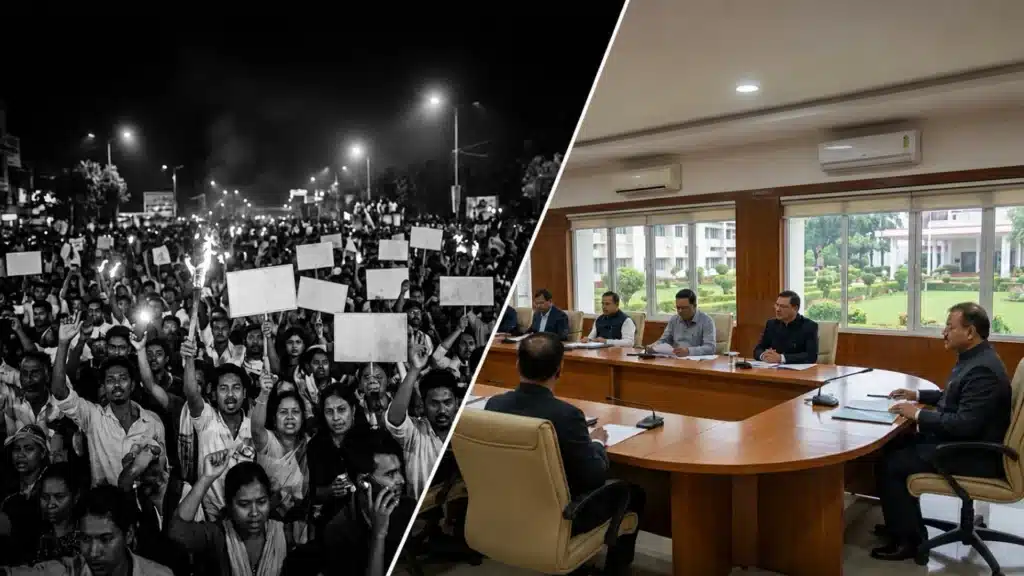
History reveals a simple truth: human progress is largely the story of protest. Whenever injustice, exploitation, and administrative paralysis accumulate, public anger boils over. Consequently, grassroots movements erupt on the streets. Particularly in a vast democracy like India, movements are never mere protest programs. Instead, they become a collective archive of hopes and dreams. They capture the public’s aspirations for a new dawn. Yet a deeply tragic truth lies beneath this brilliant dream. Looking closely at post-independence India and Assam, a clear pattern emerges. Nearly every mass movement starts with apolitical or social-reformist goals. Eventually, though, it ends in a ruthless pursuit of political power. Movement strugglers, once nurtured by turbulent emotion, eventually step into power’s air-conditioned seats. As they occupy Dispur or New Delhi, the movement’s sacred soul dies quietly. Meanwhile, the original problem never actually disappears. Instead, it transforms into a far more complex, incurable malady. Emotional publics hand governance to leaders, calling them “our boys” or “saviors.” Gradually, though, this leadership becomes part of conventional politics. This essay analyzes major historical movements in India and Assam. It also examines the psychology of power and why problems keep worsening. The Political Consequences of Apolitical Movements The relationship between movements and politics in India runs deep. Indeed, the freedom struggle against British rule remains history’s largest non-violent movement. However, later phases show a different pattern emerging. Several major examples illustrate how apolitical movements became political parties. From the Indian National Movement to the Monopoly of Congress Congress, under Mahatma Gandhi, primarily led a struggle for national independence and self-rule. Immediately after independence in 1947, however, Gandhi offered a historic proposal. He suggested dissolving Congress as a political party entirely. Instead, it would become a ‘Lok Sevak Sangh’ devoted to social service. The era’s top leaders rejected this recommendation outright. Consequently, Congress leveraged its earned moral authority to dominate governance for decades. Raised in the freedom struggle’s shadow, though, this administration failed on key fronts. It could not eradicate poverty, educational backwardness, or administrative corruption. These failures sowed the seeds for future movements. The Bihar Movement and the ‘JP Movement’ (1974–1977) One especially consequential movement began in Bihar in 1974. Student activists, led by socialist leader Jayaprakash Narayan (JP), reshaped post-independence Indian politics. Objective: This movement stayed entirely apolitical, seeking a ‘Total Revolution’ against Indira Gandhi’s corruption and inflation. Outcome: After the 1977 Emergency, this movement birthed the ‘Janata Party’. It formed India’s first non-Congress central government. Failure: Once in power, however, leaders fought bitterly over survival and supremacy. Within barely two years, the Janata Party government collapsed entirely. Ironically, JP movement leaders like Lalu Prasad Yadav, Nitish Kumar, and Ram Vilas Paswan later formed dynastic, caste-based parties. Consequently, Bihar sank back into casteism, corruption, and backwardness. Thus, the very movement fighting corruption inadvertently spawned fresh corruption. The Rise of the ‘Telugu Desam Party’ in Andhra Pradesh (1982) In the 1980s, intense regional emotion arose over alleged insults to Andhra pride. Specifically, people blamed Congress leadership in Delhi for this humiliation. Objective: This movement carried no specific political banner; instead, it protected Andhra self-respect. Outcome: Actor N. T. Rama Rao (NTR) capitalized on this sentiment, forming the ‘Telugu Desam Party’. Remarkably, TDP captured power within just nine months. Failure: Gradually, though, this identity-born party became a playground for dynastic politics. Internal rebellion, including NTR’s overthrow by Chandrababu Naidu, followed. Corporate politics eventually took hold too. India Against Corruption (IAC) and the Aam Aadmi Party (2011) Perhaps 21st-century India’s most conspicuous apolitical movement was Anna Hazare’s anti-corruption drive. It operated under the banner ‘India Against Corruption’. Objective: Rid India of corruption solely through a strong ‘Jan Lokpal’ bill, avoiding electoral politics entirely. Outcome: Arvind Kejriwal and his associates, central movement figures, sidelined Hazare’s foundational ethos. They then formed a political party called the ‘Aam Aadmi Party’ (AAP). Failure: AAP formed governments in Delhi and Punjab, yet did the system truly transform? Over time, they too embraced populist, freebie-driven politics. Gradually, their once-championed transparency dissolved completely. Eventually, prominent party leaders faced incarceration over similar corruption allegations. The Assam Movement (1979–1985) and the Asom Gana Parishad: A Tragic Social Document The ‘Assam Movement‘ was an unprecedented, spontaneous mass awakening in Assam’s history. Indigenous people took to the streets, facing an existential crisis. Unchecked illegal immigration threatened their identity, language, and culture directly. From ‘Our Boys’ to ‘Conventional Rulers’ AASU and the All Assam Gana Sangram Parishad led a six-year struggle together. This effort culminated in the historic ‘Assam Accord’, signed in 1985. Immediately afterward, student leaders formed the political party ‘Asom Gana Parishad’ (AGP). During the 1985 elections, the public offered overwhelming, emotional support. People metaphorically washed these young leaders’ feet with tears. Affectionately, they called the new rulers “our boys.” Why Did the Government Fail Completely? How Problems Multiply and Worsen? Why do movement-born governments fail to solve core problems? Instead, they often render these problems more chronic. Several psychological, social, and political factors explain this pattern. The ‘Political Marketing’ of Issues A blunt political truth applies here: fully solving the founding problem creates an existential crisis for the party. Had AGP fully expelled illegal immigrants, what issue would remain for future campaigns? Similarly, after completing Ram Mandir construction or abrogating Article 370, BJP needs fresh polarizing issues. Consequently, movement-turned-parties strategically keep core problems ‘alive’. This way, they harvest votes repeatedly instead of solving anything. The Chemistry of Power Philosopher Lord Acton famously observed: power tends to corrupt, and absolute power corrupts absolutely. On protest platforms, individuals display peak selflessness and morality. However, once they acquire state power, funds, and security, their psychology shifts noticeably. Gradually, preserving power overshadows genuine community welfare. Administrative Complexity vs. Movement Simplicity Running a movement stays linear, with clear-cut enemies and demands. Administering a state, conversely, involves constitutions, legal frameworks, and international relations. Student leaders once saw demands simply, like expelling foreigners across borders. Reality, however, proved far more complex within legal and diplomatic constraints. Unable to explain this complexity honestly, they resorted to excuses instead.