
14 August: The Horrors of Partition and National Unity
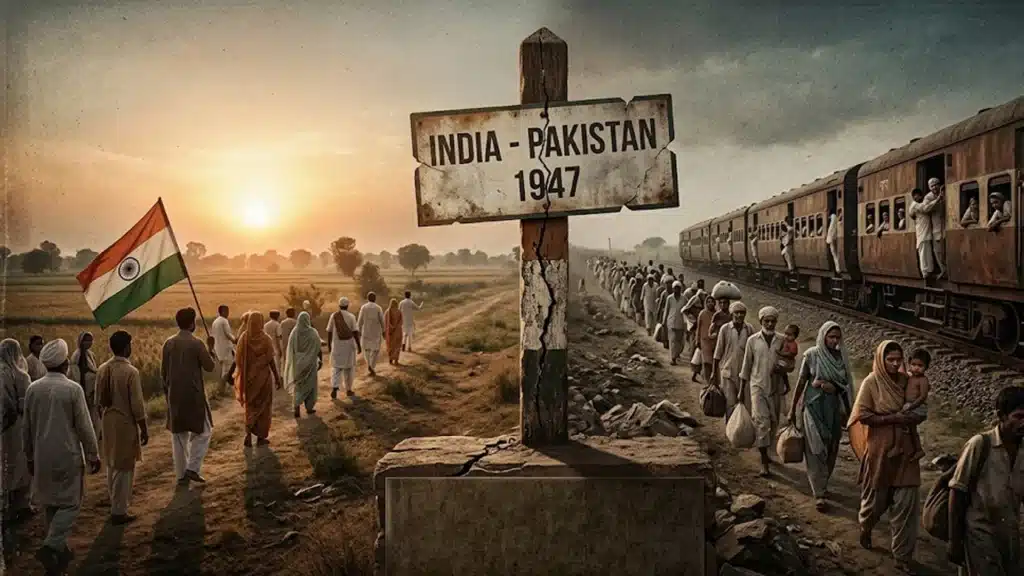
On the midnight of August 14 and 15, 1947, India rejoiced in a new dawn of freedom. Simultaneously, a deep and raw wound was carved into the nation’s chest. Behind this joy lay an unexpected and indescribable human tragedy: the Partition of India. That date was not merely a geographic division of one country into two. Rather, it marked one of the most terrible and inhumane storms in history. Consequently, power-hungry politics, British conspiracies, and shortsighted decisions shattered undivided India into pieces. As a result, countless people cried out in pain, and rivers of blood flowed. Furthermore, homelessness spread everywhere, and losing loved ones scarred millions of families. Nobody who lived through those months ever fully recovered from the trauma. Entire communities that had coexisted peacefully for generations suddenly turned against one another. Neighbors became strangers, and trust dissolved within a matter of weeks. Therefore, remembering this nightmarish day, we also honor its many victims. Accordingly, the Government of India declared August 14 as ‘Partition Horrors Remembrance Day’. Such an observance invites reflection on both grief and resilience together. Consequently, this article analyzes the social, political, and human aspects of India’s Partition. In doing so, it hopes to keep memory alive for future generations. After all, forgotten histories often repeat themselves in new and painful forms. Political Mistakes and the Historical Background of Partition The Partition of India was not an accidental event. Instead, it emerged from cunning British policies and the errors of contemporary political leadership. Indeed, both sides carry heavy responsibility for this tragedy. Moreover, decades of gradual maneuvering preceded the final catastrophic decision of 1947. Understanding these roots helps explain why the wound still lingers today. Scholars often describe the eventual outcome as neither inevitable nor entirely unavoidable. Nonetheless, a combination of ambition, fear, and mistrust pushed events toward that outcome. Consequently, examining these three factors together offers the clearest picture of what happened. Below, three key elements receive closer and more detailed examination. (A) Britain’s Policy of ‘Divide and Rule’ Starting with the Partition of Bengal in 1905, seeds of division were sown early. Subsequently, the Morley-Minto Reforms of 1909 introduced separate electorates for Muslims. Gradually, these measures deepened the rift between Hindu and Muslim communities. Meanwhile, British rulers understood that united Indian nationalism threatened their rule completely. Therefore, they deliberately patronized division along religious lines for decades. Officials calculated that a fractured society would be easier to govern. Ultimately, this calculated strategy sowed the very seeds of Partition. Consequently, mutual suspicion between communities grew steadily across successive generations of Indians. Newspapers of the era, moreover, often amplified these divisions for their own purposes. Colonial administrators, meanwhile, rarely intervened to ease the growing communal tension. Instead, they quietly benefited from a population too divided to unite against them. Over time, this engineered mistrust became embedded within everyday social and political life. Later generations inherited these divisions without fully realizing their artificial colonial origin. (B) The Struggle for Power and the Congress-League Rift Muhammad Ali Jinnah, leader of the Muslim League, proposed the ‘Two-Nation Theory’. Consequently, he demanded a separate nation, Pakistan, for South Asian Muslims. Meanwhile, Congress leaders grew eager for a swift transfer of power. Driven by haste and political maneuvering, they ultimately accepted the ominous partition proposal. Rather than resisting division, they prioritized immediate power over national unity. Sadly, this shortsighted politics, from a leadership preaching non-violence, shattered India’s undivided dream. Negotiations that should have taken years were compressed into a few frantic months. Consequently, compromises were reached without adequately consulting the ordinary people affected. Both parties, in their rush, underestimated how deeply the decision would wound millions. Later historians have argued that patience, rather than haste, might have prevented much bloodshed. Nevertheless, the political climate of 1947 left little room for careful deliberation. Ambition, fear, and exhaustion together overpowered caution at that decisive historical moment. Millions of ordinary families would soon bear the cost of these hurried choices. (C) Radcliffe’s Line and a Brutal Decision Taken in Haste British lawyer Cyril Radcliffe was brought in to mark the new border. However, he had almost no understanding of India’s geography, culture, or population. Nevertheless, he drew a single straight line across the map. This line alone determined the fate of millions of people. Within days, this brutal decision was finalized without adequate thought or care. Overnight, ordinary people became refugees upon their own ancestral land. Villages, farms, and family graves were suddenly separated by an invisible border. Neighbors who had shared festivals together now found themselves citizens of enemy nations. Maps were redrawn faster than people could comprehend what was happening around them. Consequently, confusion, panic, and desperation spread through towns along the new boundary. Many families discovered their homes had been reassigned only after violence had already begun. This chaotic execution turned an already painful decision into an outright catastrophe. Historians frequently cite this hurried boundary-making as one of Partition’s gravest failures. The Inhumane Tragedy of Partition The Partition of 1947 triggered the largest migration in human history. Simultaneously, it unleashed communal violence on an almost unimaginable scale. Truly, words remain insufficient to describe this horror. Historians still struggle to capture the full extent of the suffering. More than fifteen million people were forced to abandon their ancestral homesteads. Consequently, they crossed newly drawn borders carrying only what they could hold. Meanwhile, this migration became the world’s largest ever recorded movement of people. Families walked for days, often without adequate food, water, or shelter. Countless innocent people were slaughtered across Punjab, Sindh, and East Bengal. Similarly, violence engulfed numerous border regions on the Indian side too. Estimates suggest between one million and two million people ultimately died. Entire caravans of refugees were ambushed and massacred along their journey. Trains packed with refugees frequently arrived carrying only lifeless bodies inside. These horrifying “blood trains” became grim proof of humanity’s cruelty. Additionally, hundreds of thousands of women suffered abduction, forced conversion, and rape. Tragically, some fathers and brothers killed their own daughters to protect