
Hindu Festivals Are “Secular.” Others Aren’t.

Every Christmas, I wake up early in the morning, take a shower and then walk into a Jewish bakery to buy a plum cake. I take it home, eat it and have a perfectly good time. On the same day, I also worship Hindu gods as a part of my nityakarma (daily religious offerings). Does that make Christmas a Hindu festival? Or does my participation in it make it a secular one? Obviously not. Fine. Let’s try another thought experiment. I eat biryani on Eid. I sit with my Muslim friends, wish them Eid Mubarak and enjoy the food. Does Eid suddenly become a secular festival because I, a Hindu, participated in it? Of course not. So here is the question I keep coming back to: why does this basic logic seem to disappear when we talk about Onam? Because apparently, when Hindus, Christians and Muslims celebrate Onam together, we are expected to conclude that Onam is no longer a Hindu festival. It has apparently gone through a religious background check, seen the diversity of its guest list and emerged as “secular.” That’s a rather convenient definition of secularism. By that logic, all I need to do is invite enough people from different religions to a festival and….. Poof! Its history disappears. But festivals don’t work that way. Who celebrates a festival and where that festival comes from are two completely different questions. And if we’re going to have this conversation about Onam, perhaps we should start with the slightly inconvenient question: Where did Onam actually come from? The “Everyone Celebrates It” Argument The argument is simple enough. Onam is celebrated by Hindus. Christians celebrate it. Muslims celebrate it. People across Kerala participate in the festivities. Therefore, Onam is secular. I understand the first half. I even like the first half. There is something genuinely beautiful about people from different communities sitting together, eating the same sadya, decorating their homes and celebrating a festival together. But the second half doesn’t follow. If people from different religions celebrate something, that tells me who celebrates it today. It doesn’t tell me where it came from. Otherwise, we might as well start issuing festivals secular certificates based on attendance. “Congratulations, Christmas. Enough non-Christians attended this year. Your Christian origins have been revoked.” “Congratulations, Eid. A Hindu ate biryani. You are now officially secular.” It sounds ridiculous because it is. A tradition becoming popular beyond its original religious community doesn’t erase its history. It simply means the tradition has travelled. And before I slap the word “secular” on Onam, I think I owe the festival the basic courtesy of finding out what its story actually is. When I look at Onam today, I see a spectacular celebration. I see pookalams outside homes. I see people dressing up. I see the Onam sadya. I see boat races, dances, family gatherings and social media flooded with photographs of elaborate meals. And that’s wonderful. But a festival is rarely just what we see on the surface. There is usually a story underneath it. There is a reason a particular day is celebrated. There are traditions that explain the rituals. There are beliefs that gave the festival its original meaning. So before I decide that Onam is simply a secular cultural festival, I want to go back to the beginning. And that beginning takes me to Mahabali. The Origin Story Behind Onam The traditional story of Onam centres around Mahabali, the powerful Asura king and grandson of Prahlada. And Mahabali isn’t remembered as some cardboard villain. Quite the opposite. He is portrayed as a powerful, generous and beloved ruler. His kingdom is remembered as prosperous, and his people are deeply attached to him. But Mahabali’s growing power eventually brings him into conflict with the divine order. Enter Vishnu, appearing as Vamana, a dwarf Brahmin. Vamana approaches Mahabali and asks him for three paces of land. Mahabali, known for his generosity, agrees. And then the story takes a rather spectacular turn. Vamana expands into a cosmic form. With his first step, he covers the earth. With his second, he covers the heavens. Now there is nowhere left for the third step. Mahabali has given his word. So he offers his own head. Vishnu places his foot on Mahabali’s head and sends him to the netherworld. But the story doesn’t end there. Mahabali is granted a special privilege: he is allowed to return once every year to visit his people. And that annual return is at the heart of the traditional Onam story. Now, I can believe this story literally, metaphorically, spiritually, or not at all. That’s a different debate. But whether I believe a religious story is true has absolutely nothing to do with whether that story is the religious origin of a festival. I don’t have to be a Christian to understand the Christian origins of Christmas. I don’t have to be Muslim to understand the Islamic significance of Eid. And I don’t have to believe the Mahabali story to acknowledge that it is central to the traditional Hindu understanding of Onam. I can question a story without pretending the story never existed. “But Isn’t It Just a Myth?” This is usually where someone will say, “But it’s mythology.” Yes. Let’s assume it is. And? Religious traditions are full of stories that communities have preserved for centuries. Calling something a myth doesn’t magically make it irrelevant to the history of a festival. If I tell you the story behind Christmas, I will talk about Jesus. If I explain Eid in its religious context, I will talk about Islam. If I explain Onam in its traditional religious context, I have to talk about Mahabali and Vamana. That’s not propaganda. That’s called knowing what you’re talking about. Whether someone personally believes in Vishnu, Vamana or Mahabali is beside the point. If tomorrow I decide I don’t believe in the historical claims surrounding Christmas, Christmas doesn’t suddenly become secular. My personal disbelief doesn’t rewrite the festival. And neither does someone
Rationalism and Religious Truth
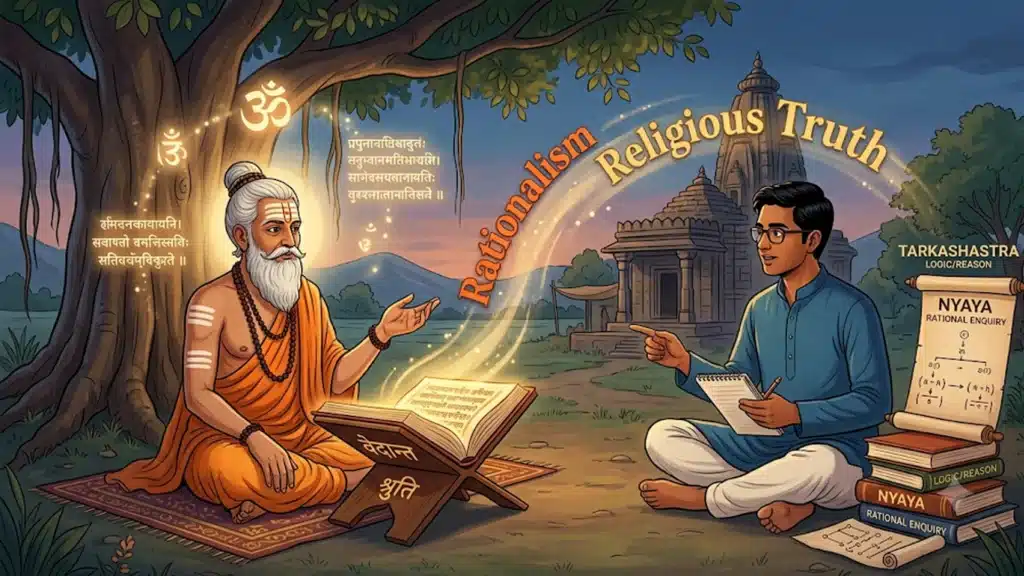
Imagine a dark night. A man searches for something on a table inside his house. There is no light inside. It is completely dark. Outside, however, a street lamp shines brightly. Finding it hard to search in darkness, the man steps outside. He begins searching under the lamp instead. A passerby notices him and asks what he is looking for. The man replies, “I lost my key ring.” The passerby then asks where exactly he lost it. “Inside the house,” the man answers. Surprised, the passerby asks why he is searching outside then. The man replies simply. “It is dark inside, so searching is hard. There is light here, so I search here.” This story feels familiar today. Watch a section of people who call themselves “rationalists.” More often than not these rationalists will refuse to search for the ‘rational truth’ in the inconvenient place of darkness (religions that are militant and hostile in nature) and instead flock to the convenient place of rationalising Religions that are already in the firing line most often – such as Christianity or Hinduism. The problem with this approach that a coherent worldview simply cannot be formed with such a biased methodology, true rationality cannot be forged this way. Problems, superstitions, and dogmas exist in every religion. They exist in every community too. Yet when it comes to criticism, people question only what is easy. They question only where there is no danger. They question only where tolerance shines like that street lamp. Where real darkness or extremism exists, hesitation quickly appears instead. This pattern raises an important question. Is this modern trend true rationalism? Or is it merely a one-sided, selective agenda? What Rationalism Actually Means The word “Rationalism” did not begin on social media. It is instead a deep and systematic philosophical movement. It has centuries of history behind it. Rationalism found firm footing through philosophers like Descartes, Spinoza, and Leibniz. Their work flourished during Europe’s 17th and 18th century Enlightenment. Three pillars support rationalism’s core foundation. First, evidence and logical judgment matter most. Every conclusion must rest on evidence and logic. Second, objectivity is essential throughout. The same rules must apply to everyone, regardless of religion, race, or politics. Third, open-mindedness remains crucial as well. A rationalist must be willing to change views when new evidence arrives. For a true rationalist, ultimate truth is the only goal. There should be no religious exemptions anywhere. At the same time, however, malice toward any culture is equally unacceptable. Genuine rationalism therefore walks a careful, balanced line. It seeks truth without either favoritism or hostility. Logic and Inquiry Within Indian Tradition Many people today assume that “questioning” arrived from Western culture. However, Indian philosophy was built on debate since ancient times. Critical analysis was never foreign to this tradition. Beyond the six orthodox schools, called Saddarsana, other traditions thrived too. Nyaya, Vaisheshika, Samkhya, Yoga, Mimamsa, and Vedanta formed the orthodox core. Alongside them, heterodox and rationalist philosophies were equally respected. Charvaka philosophy stood among these, along with Buddhist and Jain thought. Charvaka sages accepted only direct perception, or Pratyaksha, as truth. They questioned Vedic principles and rules openly. Even so, society still honored them as Rishis or Maharshis. This fact proves something important about Indian tradition. Questioning was never prohibited within it. Instead, inquiry was considered the very first step toward knowledge. What the Bhagavad Gita Reveals Consider the Mahabharata’s Bhishma Parva next. Within it, the Srimad Bhagavad Gita records a remarkable dialogue. Arjuna and Sri Krishna engage in genuine debate and logic. Arjuna never accepted Krishna’s words blindly or passively. In Chapter 4, Verse 34, Krishna himself describes how knowledge is gained: Tad viddhi pranipatena pariprasnena sevaya | Upadeksyanti te jnanam jnaninas tattva-darsinah || This translates roughly as follows. Learn the truth by approaching a spiritual master humbly. Inquire from him submissively, and also render him service. Self-realized souls can then impart true knowledge to you. Notice the word “pariprasnena” here carefully. It signifies questioning the master directly and clearing doubts. Understanding truth through logic aligns fully with Dharma, or righteousness. Even more strikingly, Krishna does not force his views onto Arjuna. In Chapter 18, Verse 63, he says the following instead: Iti te jnanam akhyatam guhyad guhyataram maya | Vimrsyaitad asesena yathecchasi tatha kuru || This means Krishna has now explained the most confidential knowledge available. He then tells Arjuna to deliberate on it fully. Afterward, Arjuna should act according to his own wish. When scripture grants such freedom, even regarding God’s own words, a question naturally follows. How fair is it, then, to call this same tradition “anti-logic”? The Trouble With Selective Rationalism Today, we observe a troubling pattern among self-styled rationalists. A section of them targets mainly Hinduism, its rituals, and its festivals. Several clear contradictions emerge once we look closely. First, consider Diwali compared to other celebrations. When Diwali arrives, articles and speeches address firecracker pollution immediately. Preventing pollution is, of course, a genuinely logical concern. Yet during other festivals, thousands of firecrackers also get burst. Similarly, animals are slaughtered in large numbers during other festivities. Suddenly, though, these same rationalists fall silent on environmental harm. Second, look at how customs and practices get criticized. Idol worship, temple visits, and applying tilak face constant mockery. Critics call these acts “blind faith” or “wasted resources” repeatedly. Meanwhile, faith healing in other religious spaces goes unchallenged. Collections made in the name of holy water also escape scrutiny. Dress-related religious compulsions elsewhere receive little to no criticism either. Third, notice the one-sided stance on social reform generally. Reformers like Raja Ram Mohan Roy emerged from within Hindu society itself. Swami Vivekananda and Dr. B.R. Ambedkar did the same important work. They opposed caste discrimination, Sati, and untouchability directly and openly. Society, as a result, gradually transformed for the better. However, when other religious societies restrict women’s rights, rationalists often stay quiet. Polygamy and religious conversions elsewhere get defended as “personal freedom” instead. Why Hinduism Alone Gets Targeted Several psychological, social, and