
Rare Earth Elements: The Story of Indian-Mongolian Alliance
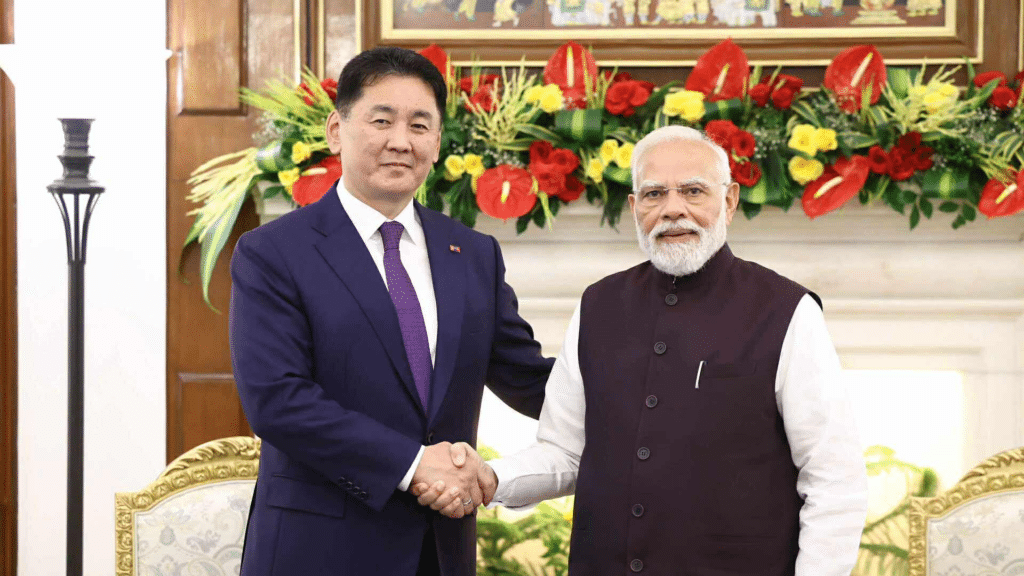
2025 marks the 70th anniversary of diplomatic relations between India and Mongolia, which were first established on 24th December 1955. Breaking with its ideological allies, India became the first country outside the socialist bloc to establish such relations. Most recently, Indian Prime Minister Narendra Modi met with the Mongolian President Khurelsukh Ukhnaa on the 14th of October at New Delhi’s Hyderabad House. The two countries signed ten pacts for a period of about ten years, signaling a new era of cooperation. China’s Stranglehold on Rare Earth Elements The Gobi Desert, which encompasses certain northern parts of China and southern Mongolia, is widely believed to hold huge reserves of lithium, graphite, and REEs or Rare Earth Elements. These are a group of 17 chemical elements which include scandium, yttrium, and lanthanides. These elements, which are abundant in the Earth’s crust, are critical to the production of many modern technologies like cell-phones, televisions, etc. While China holds the largest reserves of these elements at about 44 million tons, Mongolia crucially occupies the second position with 31 million tons according to a 2009 estimation by the US Geological Survey. China has brutally exercised its monopoly over these elements, most recently by placing restrictions on its exports of REEs. Industry leaders in India concede that this restriction impacts the import of components, sub-assemblies, and specific light rare earth magnets which they had been using earlier. Critically, Electric Vehicle motors require these components for operation. According to Nitin Gadkari, Union Minister Road Transport and Highways, India seeks to attain 30% share of EVs among total vehicles sold by 2030. The nation plans to become the world’s largest EV manufacturer. The solution to China’s chokehold on REEs? According to Bai Chong-En (Dean of the School of Economics and Management at Beijing’s Tsinghua University), India should allow Chinese investment and production of EVs for them to eventually learn and start its own manufacturing. This would make the nation even more reliant on China not just as an exporter of REEs but also as a producer of EV engines. How India Can Benefit From Mongolia Here is where the pact between India and Mongolia comes in. At present India is looking at the options of buying coking coal from the Eastern Asian nation. If India has to buy this coal from Mongolia it must be through Tianjin port in China or Vladivostok in Russia. Furthermore, India is spending around $1.7 billion on an oil refinery project in Mongolia and is also looking at strengthening cultural ties. Not only is the pact limited to these areas, but it is also exploring possibilities of cooperation in areas such as energy, critical minerals, rare earths, digital and mining. Mongolia is thereby emerging as a potential and reliable alternative to China in the import of REEs for India. Prime Minister Modi termed the two nations as “spiritual siblings”. It is time for these “siblings” to come together and take advantage of the globalised world to work together and pose a challenge to China’s monopoly by effective discovery and extraction of REEs. If India strategically uses this partnership, it can hope to achieve its goal to be an EV manufacturing giant by 2030. (The author is a student at Ashoka University)
Reflections on World Book Day
A silent room.On the table lies an old book. Its pages flutter in the wind… Each page feels like a story, each word like a life and every sentence like a doorway to a new world.These books, even in their silence, speak to us, capable of bringing revolutions without making a sound. They transform individuals, shape societies and write history. Today’s world is moving through an era of unprecedented change. The explosion of technology, the overwhelming flow of information, and a mechanized lifestyle have completely transformed human thought, behavior, and the rhythm of life. Yet, amid this rapid pace, an ancient yet timeless force continues to stand at the core of our existence; that force is the book. A book is not merely a repository of knowledge; it is the soul of human civilization, a reflection of thought, and an intimate dialogue between humanity and time. It is to honor this profound force that the world celebrates World Book Day every year on April 23. This observance was initiated in 1995 by UNESCO. Its primary aim is to promote the culture of reading, recognize the creative contributions of authors, and establish a strong intellectual foundation within society. The choice of April 23 carries deep significance as well — on this very day, two immortal figures of world literature, William Shakespeare and Miguel de Cervantes, departed from this world. Thus, the day is not merely a celebration; it is a sacred occasion of remembrance, respect, and inspiration. A book is not just a collection of words. It is a living force that touches the human mind, intellect, and soul. A book can show new directions, illuminate the darkness, and help us understand the meaning of life. In this regard, a quote by Rabindranath Tagore is especially relevant: “Reading is the expansion of one’s soul.” This statement beautifully captures the depth and inherent power of reading. In today’s modern age where mobile phones and social media have become inseparable parts of daily life, the habit of reading books is gradually declining. The ease of instant information offers a convenient path, but this convenience lacks depth. Reading a book demands time, focus, and reflection. This process enhances intellectual capacity, cultivates rational thinking, and provides a healthy perspective on life. The true development of a society does not depend solely on economic indicators. A truly advanced society is one where people think, question, and seek truth. The foundation of such a mindset lies in books. Books teach us to learn from history, understand the complexities of the present, and choose the right path for the future. As Mahatma Gandhi once said, “A book has the power to change a society.” This is a profound truth. Books nurture empathy, tolerance, and human values within individuals. By reading a novel or a biography, we can experience another person’s life, their joys and sorrows, struggles, dreams, and philosophies. This experience makes us more sensitive and humane. In times like today, when division, hatred, and intolerance are on the rise, books can serve as a powerful bridge across these divides. Moreover, books enhance creativity and imagination. Through reading, individuals envision new worlds, generate new ideas, and explore new paths. Whether in science, literature, art, or any field, creativity is rooted in knowledge and books remain its primary source. History has shown that all great individuals who brought about revolutions in the world were deeply connected with books. The significance of World Book Day lies precisely here, it compels us to reflect on our own habits. It urges us to ask an important question: how much do we read? How much time do we invest in acquiring knowledge? The answers to these questions will shape both our personal lives and the future of our society. Reconnecting the younger generation with books is especially crucial. Cultivating the habit of reading from an early age is essential. Schools, families, and society all have an important role to play in this. Once reading becomes a habit, it becomes an inseparable part of life, guiding individuals toward the right path. In this context, the social role of books is immensely important. Books free society from superstition, inspire rational thinking, and illuminate the path of truth. When a society begins to read, awareness grows, the sense of justice strengthens, and a healthy democratic environment takes shape. Therefore, on this World Book Day, let us not limit ourselves to mere celebration. Let us take a firm pledge to dedicate at least some time every day to reading. Let us encourage our families, friends, and communities to embrace the culture of reading. Together, let us move forward together to build a knowledge-based, aware, and empowered society. For a book is not merely a bundle of pages — it is the strength of the present and the vision of the future. When a society respects books, it can never sink into darkness. Books keep a society alive, awaken its people, and give them the courage to move toward a brighter future. And when the digital screens fade, when the noise falls silent, what will remain with us? A book. Page by page, thought by thought, a ray of light.A book is not just paper. It is a force that transcends time, an immortal embodiment of human thought, and a lighthouse guiding society from darkness to light.