
“Say Jai Shri Ram, not just Inshallah”: Himanta to Mamata
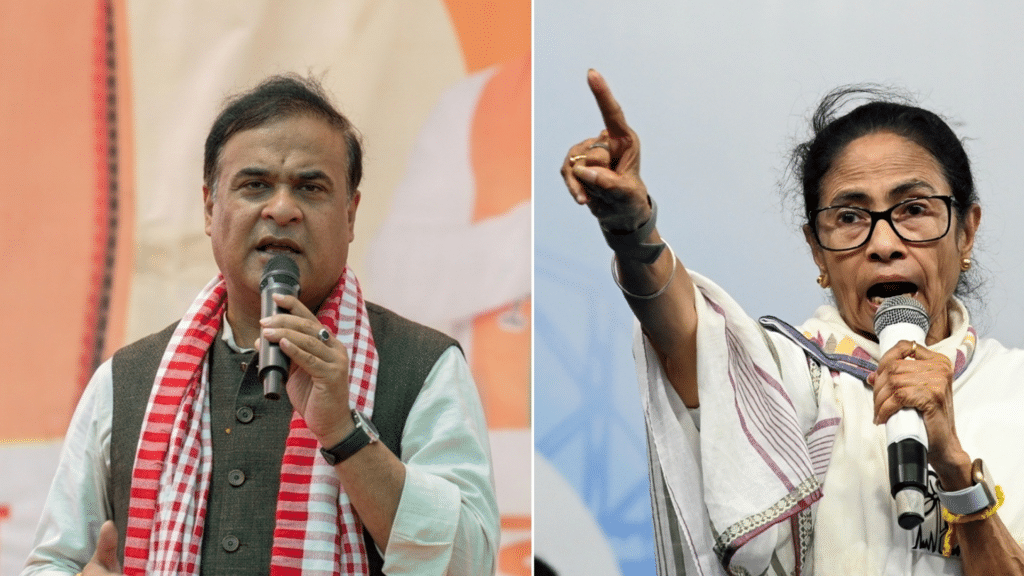
Assam Chief Minister Himanta Biswa Sarma criticized West Bengal Chief Minister Mamata Banerjee during the ongoing election campaign, accusing her of selective messaging in her speeches. Addressing a public meeting, Sarma said he closely follows Banerjee’s campaign addresses and claimed she often uses phrases like “Inshallah” and “Khuda Hafiz” while speaking to certain sections of voters. He added that she should also say “Jai Shri Ram,” arguing that her rhetoric does not appear inclusive. The remarks come amid an ongoing war of words between leaders of the Bharatiya Janata Party (BJP) and the Trinamool Congress (TMC). The BJP has repeatedly accused the ruling TMC of engaging in appeasement politics, an allegation the party has consistently denied. Sarma’s comments have further intensified the political discourse in West Bengal, where both sides are using strong rhetoric to mobilize support. The Trinamool Congress has not yet responded to his statement.
Five teachers detained over alleged Beef in mid-day meal in Rohtas

Authorities in Bihar’s Rohtas district have suspended and detained five teachers after more than 7 kg of suspected beef was recovered from a government school’s mid-day meal. The meat was found stored in polythene bags inside a classroom at Utkramit Urdu Middle School in Ramudih village. The discovery sparked protests from parents and local residents, who expressed concerns over religious sensitivity and demanded strict action. The district administration suspended five staff members, including the in-charge headmaster, while police detained them for questioning. Officials said an investigation is underway to determine how the meat was brought onto the school premises and whether it was intended for the mid-day meal.
Alleged proxy voting reported in Siliguri; claims a young voter
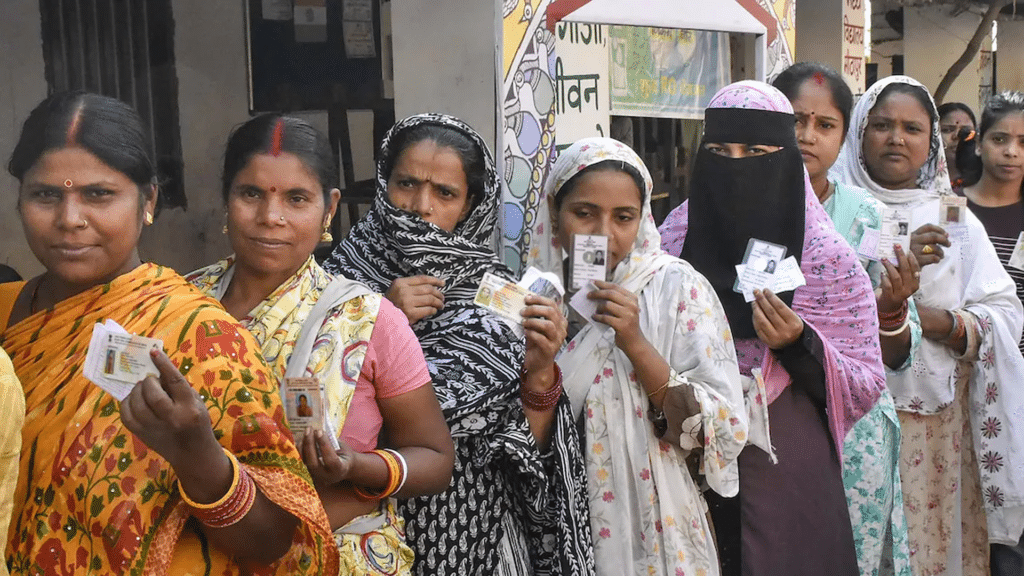
Reports of voting irregularities have emerged from Booth 235 in Siliguri during the ongoing West Bengal Assembly elections, after a woman alleged that her vote had already been cast before she arrived to vote. The voter was taken aback upon being informed that her ballot had been recorded, prompting concerns about possible proxy voting at the booth. A representative of the Bharatiya Janata Party present at the polling station intervened, examining the matter and displaying documents on a mobile phone in an attempt to verify the discrepancy. The BJP has since brought the issue to the notice of the Election Commission of India, urging a prompt investigation and corrective action over the alleged lapse.
TMC workers block BJP polling agent in Kumarganj
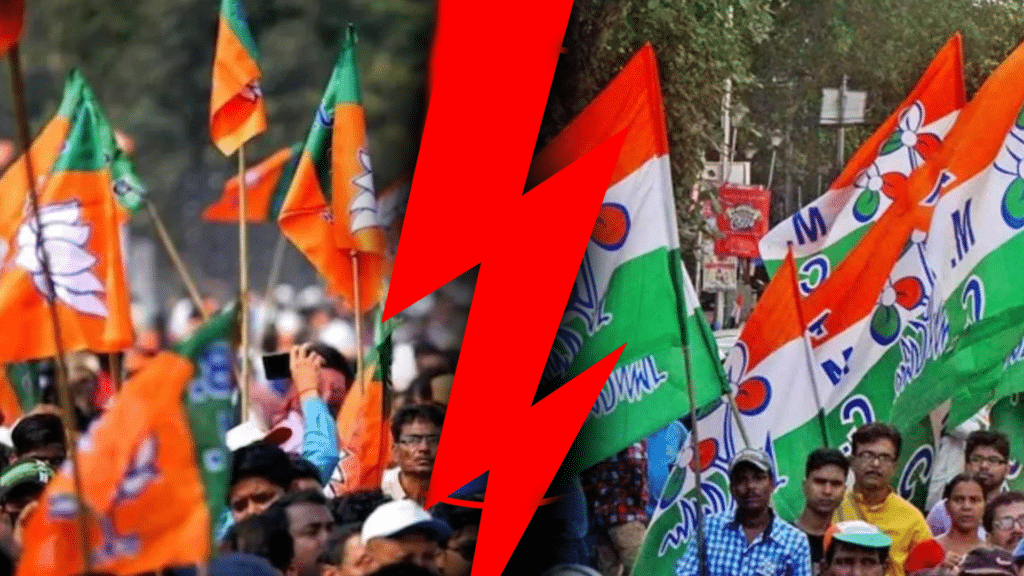
Voting in Kumarganj on Thursday witnessed disturbances, with videos circulating of Trinamool Congress workers attempting to allegedly prevent a Bharatiya Janata Party polling agent from entering a booth. The situation escalated when local BJP supporters arrived at the spot and intervened, leading to a brief confrontation between the two groups marked by heated arguments. The TMC workers subsequently moved away from the area. The incident took place amid the ongoing West Bengal Assembly elections, which have seen reports of sporadic tensions and allegations of voter intimidation in several parts of the state. Security personnel were deployed to maintain order, and polling continued after the situation was brought under control.
Hindu man forced to remove religious flag by mob in Kolkata
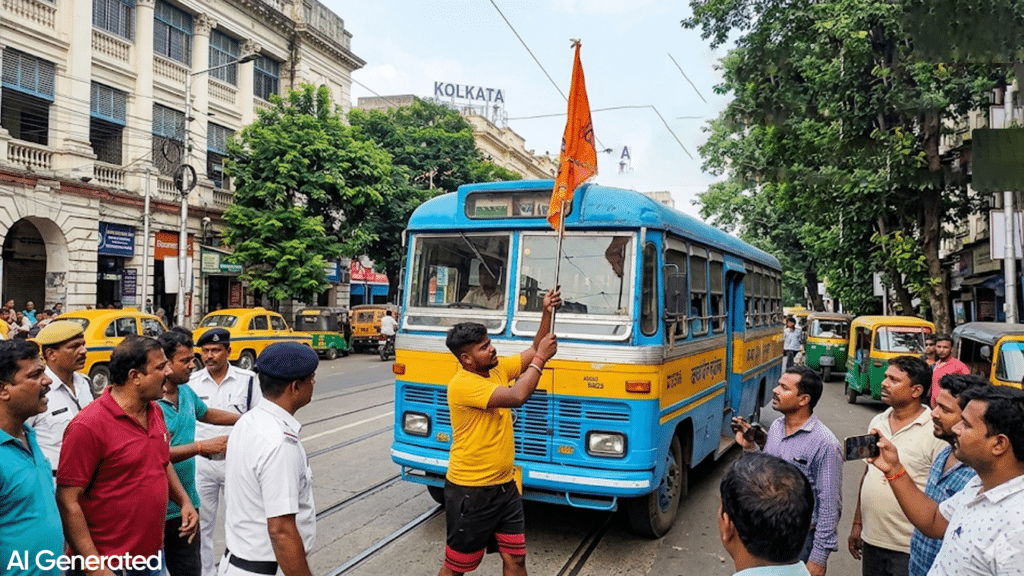
A video from Kolkata, reportedly dated April 23, shows a Hindu man being forced by a group of people to remove a saffron flag from his vehicle. The footage has been widely shared online and appears to show a verbal altercation escalating near a polling-related location. In the video, the man is later seen removing the flag from his vehicle. However, the authenticity of the clip and the full context of the incident have not been independently verified. The video has sparked widespread reactions on social media, with users and some political voices expressing concern and demanding action. Questions have also been raised about voter safety and whether the polling process is being conducted in a free and fair manner.
The Red Cloth Between Two Lands
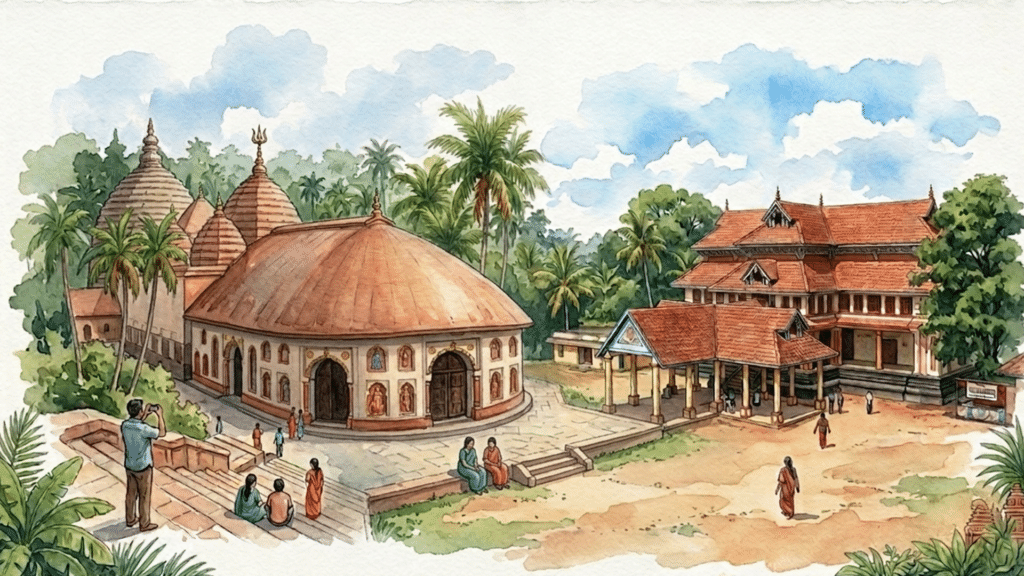
The first thing I remember is the smell of wet stone. Not temple at first. Not even faith. Just stone, darkened by rain, warmed by oil lamps and carrying that faint metallic scent that comes only in places where water and belief have been meeting for centuries. I grew up in Guwahati, and like most things there, Kamakhya was not introduced to me. It was absorbed. The hill was always there, half-hidden in cloud. The stories were always there too, half-whispered, half-assumed. That this is where Mother Sati’s yoni fell. That the earth itself became feminine there. That the Goddess bleeds once a year and the temple closes, not in mourning, but in respect. As a child, you don’t question that kind of thing. You just learn that the world has places where it behaves differently. And Kamakhya is one of them. During Ambubachi, the city changes. It is not a festival in the usual sense. It feels more like an agreement between people and something larger than them. The temple gates close, but the hill does not become empty. It becomes fuller in a strange way, sadhus sitting under plastic sheets, women carrying red cloth bundles, men chanting softly as if sound itself has to be careful not to disturb something resting. Even the rain feels slower. I remember once standing there with no real plan, just following the movement of people. Someone nearby was chanting Devi Mahatmyam, and another group was singing something I didn’t recognise, but the rhythm was familiar anyway. Everything felt like it was circling around a silence at the centre of the hill. During my study, I asked my Guru, Jayashankar Rajagopalan, over WhatsApp, about Chengannur where a similar ritual is followed and expressed my desire to visit there. Years later, he invited me to Kerala, “I will fulfill your wish to go to the kshetra of the menstruating Bhagavati in Chengannur.” *** Kerala arrived like a different kind of green. Not the dense, almost wet green of Assam, but something more arranged. Palms standing apart like they had chosen their distance carefully. Houses with sloping roofs that seemed permanently prepared for rain. Even the air felt less chaotic. Chengannur is not a place that tries to impress you. If anything, it hides its weight under ordinariness. The temple, Chengannur Mahadeva Temple, does not announce itself loudly. You almost walk into it before realising you have arrived. Inside, things feel older than language. I had been told about it before coming. That here, the devi is believed to undergo her monthly cycle. That a white cloth placed in the sanctum is checked, and at certain times it is said to turn red. That during this period, the garbhagriha of the Bhagavathy closes. I didn’t know how to hold that information at first. Kamakhya I understood in fragments because I had grown up around it. But here, far away in Kerala, the same idea existed in a different accent, a different ritual grammar. It unsettled something in me. Not disbelief. More like recognition without preparation. *** On the day I visited, the sanctum sanctorum of the temple was not in its closing phase, but the atmosphere carried that possibility in it, like a sentence that knows its ending even when it hasn’t been spoken yet. The priests moved with quiet efficiency. Nothing theatrical. Nothing rushed. Everything felt measured, as if time itself had been trained here. I stood near the inner corridor for a while, just watching people come and go. Most did not speak much. Some touched the walls as they passed, not dramatically, just briefly, like checking if something was still there. That gesture stayed with me. Because it wasn’t devotion in the loud sense. It was familiarity. What I had been told by my Guru began to make sense slowly. Kamakhya in Assam belongs to a world that people often describe using big categories, Kaula, Vamachara, Tantra, the language of texts like the Kalika Purana and Yogini Tantra. But none of that really captures what it feels like on the ground. What you actually see there is simpler: people accepting that divinity is not distant from the body. That it can bleed. That it can rest. That it can withdraw. In Kerala, the same idea arrives through a different discipline. The ritual system is more structured, shaped by traditions like the Tantrasamuchaya. Everything is cleaner, more codified, more contained. But underneath that order, the same imagination is alive. That the Goddess is not static. That she has cycles. That the temple responds to them. Two regions. Two languages. Two ritual architectures. But something shared that is harder to name. *** That evening, I saw a group of women seated near the temple courtyard. They were singing the Lalita Sahasranama. Not loudly. Not for performance. Just steady repetition, like breath being given sound. I don’t know how long I stood there. Time behaves differently in those spaces anyway. But at some point, I realised it reminded me of something I had heard in Kamakhya during Ambubachi, people sitting in loose circles chanting the Devi Mahatmya, voices mixing with rain, with drums, with silence between syllables. The same feeling appeared again. Not sameness of ritual. But sameness of atmosphere. A shared understanding that repetition is not emptiness. It is accumulation. *** What struck me most between Kamakhya and Chengannur was not similarity in doctrine. It was similarity in tolerance for ambiguity. Both places allow the Goddess to be in a state that is not permanent. Not always present in the same way. Not always “available” in the way modern thinking expects divinity, or even institutions, to be. There is something deeply unmodern about that. And maybe that is why it stays with you longer than explanations do. *** When I left Chengannur, nothing felt concluded. I didn’t feel like I had “understood” anything in a neat sense. If anything, I had gathered a few impressions that refused to align into a single thought:
₹2 crore cash seized from DMK candidate’s aide in Mylapore

Ahead of the 2026 Tamil Nadu Assembly elections, Election Commission teams seized nearly ₹2 crore in cash from the residence of Sathyamoorthy, who is associated with DMK candidate Dha. Velu, contesting from the Mylapore constituency. The raid was carried out in Chennai’s Mylapore area as part of checks aimed at preventing electoral malpractice during the ongoing campaign period. Officials said most of the recovered money was in ₹500 denomination notes. During the search, authorities also found voter lists and documents that appeared to contain distribution records. Investigators suspect these papers could be linked to alleged attempts at voter inducement, and they are currently being examined in detail. Election Commission authorities have confirmed that the matter remains under investigation, and efforts are underway to establish the source of the cash and the purpose for which it was intended.
CAPF detains TMC cadres after attack on BJP roadshow
Central Armed Police Forces personnel detained several individuals, including a local Trinamool Congress worker identified as Molla Harmad, following a clash that broke out during a BJP rally in Dantan area of Paschim Medinipur district, West Bengal. The incident reportedly began when supporters of different political parties engaged in an argument during a campaign event linked to the upcoming 2026 Assembly elections. The situation soon escalated into a physical confrontation, with BJP workers alleging they were attacked by opposing party supporters. Visuals from the spot show security forces intervening, detaining several people, and escorting them to a nearby police station. Following the clash, some motorcycles were reportedly set on fire, and several party workers sustained injuries. The BJP has claimed that one of the detained individuals was a key instigator behind the violence and has demanded strict action against those responsible. However, authorities have not independently confirmed these allegations and have stated that an investigation is currently underway to establish the exact sequence of events.